Apartment Strength Training: The Complete Quiet Progression Guide
Quick Answer: Quiet strength training works because muscle responds to tension and time under load, not to impact. Replace explosive and dropped movements with slow eccentrics, isometric holds, unilateral work, and band tension, and you can progress for a year or more without a single loud rep. The three noise sources to eliminate are foot impact, weight-to-floor contact, and equipment rattle, and each has a direct substitute.
You have been told that a real workout requires jumping, dropping, or a rack. It does not. What it requires is progressive overload, and there are at least four ways to get that in a third-floor apartment at 10pm.

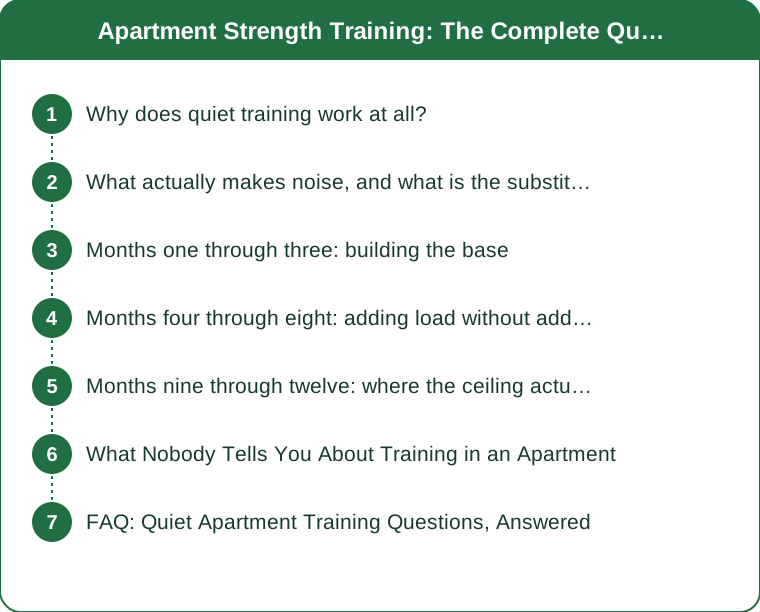
Why does quiet training work at all?
Because the thing that drives adaptation is mechanical tension on muscle, and impact is not required to produce it.
Muscle grows and gets stronger in response to high tension applied across a sufficient number of hard efforts. The classic route is external load: pick up something heavy, move it, put it down. But tension can also be raised by slowing the movement down, by extending the time a muscle spends under load, by removing the easy portion of the range, or by loading one limb at a time.
A slow eccentric is a clear example. Lowering into a squat over five seconds rather than one substantially increases the time the quadriceps spend under tension, and the eccentric portion of a movement is where a great deal of the adaptive stimulus lives. Doing this with body weight alone produces a genuinely hard set for most people, and it makes no noise whatsoever.
Isometrics work by a different mechanism but land in the same place. Holding a position at a mechanically difficult joint angle produces very high tension with zero movement, which means zero impact. A 30-second wall sit at the right depth is a serious quadriceps effort and is completely silent.
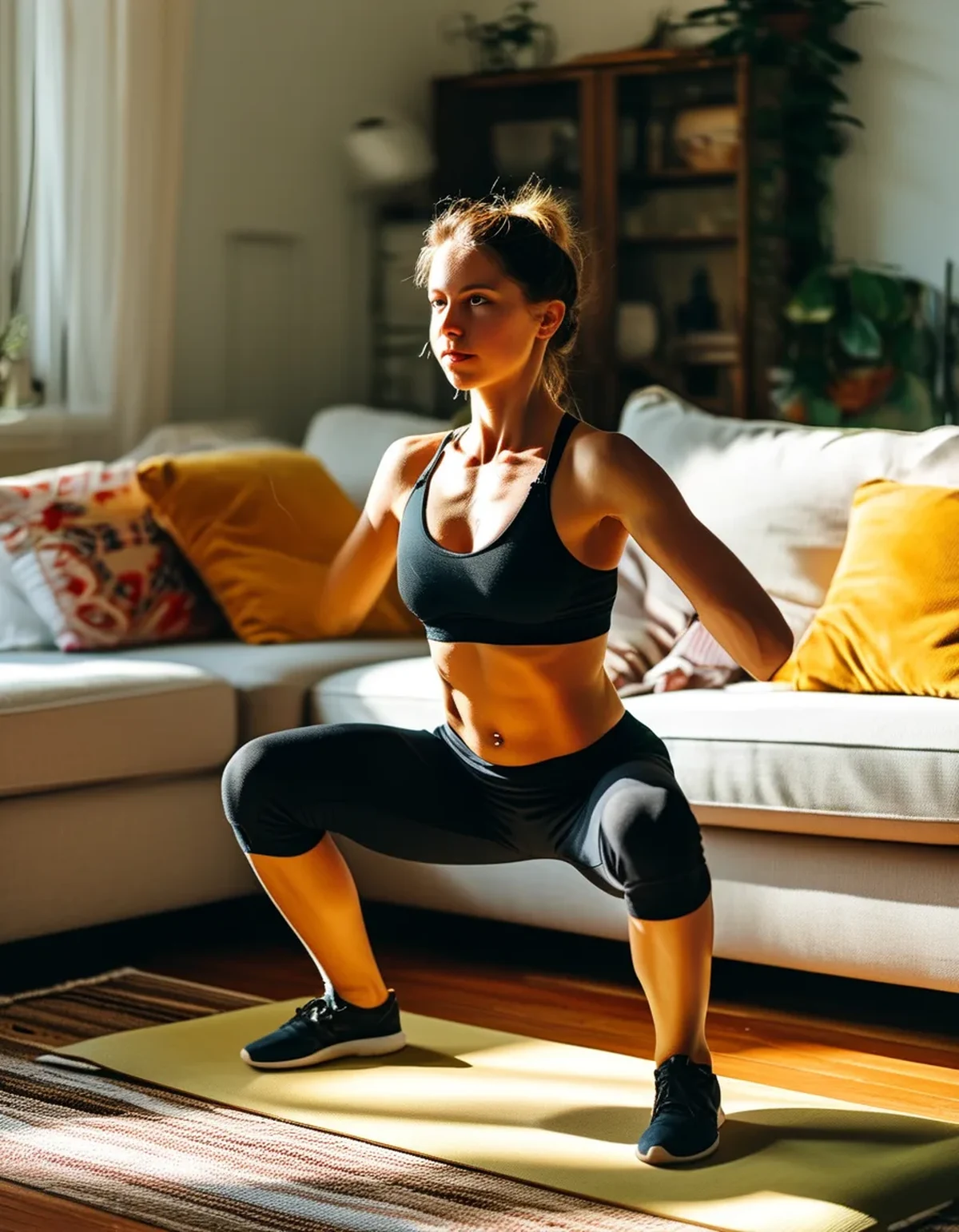
Unilateral work is the third route, and it may be the most underrated. Standing on one leg roughly doubles the load on that leg without adding a single pound of equipment, and it simultaneously demands balance and hip stability that bilateral work does not. A Bulgarian split squat with body weight only is harder for many people than a loaded back squat, and it is silent.
Bands provide the fourth route. Elastic resistance increases as the band stretches, which means the hardest point of the movement lands where you are strongest, and there is no mass to drop and no plate to clang.
The honest limitation: at the very top end of strength development, heavy external load remains the most efficient tool, and someone chasing a 300-pound squat will eventually need a barbell. For the overwhelming majority of people training for strength, muscle, and health, quiet methods are not a compromise. They are simply a different set of tools that happen to also be considerate.
What actually makes noise, and what is the substitute for each?
Three distinct sources, and confusing them leads people to eliminate the wrong things.
Source one: foot impact. Jumping, running in place, jumping jacks, burpees, and box jumps. This is the loudest category by a wide margin because it transmits directly through the floor structure as low-frequency vibration, which is exactly the frequency that travels best through a building and is least affected by soft flooring.
The substitute for impact is not a quieter jump. It is a movement that trains the same quality without leaving the ground. Explosive power can be trained with heavy, fast concentric intent against resistance that does not allow actual leaving of the ground, such as a band-resisted squat where you push as hard as possible. Conditioning can be trained with movements like mountain climbers done with controlled foot placement, skater steps without the hop, or simply higher-rep strength circuits with short rest.
Source two: weight-to-floor contact. Setting dumbbells down, dropping kettlebells, and the small but audible thud of a plate meeting the ground. This one is the most fixable of the three.
The substitutes are straightforward: adopt a strict rule that weights are placed rather than dropped, use lighter weights with slower tempo so placement is always controlled, and put a dedicated mat under the training area. A 1-inch rubber or high-density foam mat absorbs most of what remains after you have stopped dropping things.
Source three: equipment rattle. Adjustable dumbbell plates knocking, a bench creaking, a door-frame pull-up bar shifting, a resistance band clip tapping the floor.
This is solved by equipment choice rather than technique. Fixed dumbbells are silent where adjustable ones rattle. A well-fitted door-frame bar is quiet where a loose one is not. Fabric-covered bands do not slap. Checking each piece of equipment individually, by using it deliberately and listening, identifies the culprits in about ten minutes.
The ranking matters: eliminate impact first, because it accounts for the large majority of complaints and no amount of matting fully solves it. Then fix placement habits, then fix equipment.
Months one through three: building the base
The first quarter is about establishing movement quality and a training habit, and body weight is genuinely sufficient here.
Frequency: three sessions per week, full body, with at least one day between them. This is not a compromise for beginners, it is close to optimal for the first several months, because frequency of practice matters as much as volume in the early phase.
The core movements: a squat pattern, a hinge pattern, a push, a pull, and a carry or core brace. Everything else is optional.
For the squat pattern, start with a body weight squat performed with a three-second lowering phase, a one-second pause at the bottom, and a controlled rise. Three sets of eight to twelve. The tempo is the load in this phase, and rushing it removes most of the value.
For the hinge, a body weight Romanian deadlift pattern with a broomstick or dowel held against the back to teach a neutral spine. This looks trivially easy and is not, particularly with a slow tempo and a full stretch at the bottom.
For the push, incline push-ups with hands on a counter or a sturdy table. Elevating the hands reduces the load and lets you accumulate quality reps. Progress by lowering the surface over weeks: counter, then a chair seat, then the floor.
For the pull, a band row anchored in a door or under a closed door, or an inverted row using a sturdy table edge. This is the pattern most home setups neglect and the one most desk workers need most.
For the carry or brace, a suitcase carry with a single heavy household object, or a plank progression. Thirty to forty-five seconds per set.
Progression during this phase: add one rep per set per week until you reach the top of the range, then increase the tempo difficulty, then move to the harder variation. Write it down. The single biggest failure mode in home training is not tracking, which means progression happens by accident or not at all.
Expect to be surprised by how hard week three feels. Slow tempo work produces significant soreness in people who are used to fast reps, and that settles within two to three weeks.
Months four through eight: adding load without adding noise
By month four, body weight with slow tempo stops being sufficient for the lower body in particular, and this is where most quiet programs stall. The way through is unilateral work plus bands, in that order.
Unilateral lower body is the main tool. Move from two-leg squats to split squats, then to rear-foot-elevated split squats with the back foot on a chair, then to adding a slow tempo to those, then to holding household weight. Each of those steps is a meaningful jump in difficulty, and together they cover several months of progression with no equipment at all.
The single-leg Romanian deadlift does the same for the posterior chain. It is genuinely difficult to balance at first, which is part of the training effect, and the load on the working hamstring and glute is roughly double the bilateral version.
Bands cover the upper body and the pulling patterns. A set of loop bands in three tensions costs very little and provides progressive resistance for rows, pull-aparts, presses, and pull-downs. The progression is band tension, then band tension plus slowed tempo, then increased range by standing further from the anchor.
Adjustable dumbbells become worth it around here if the budget allows, with the caveat about rattle above. Fixed dumbbells in two or three weights are quieter and often cheaper secondhand. A pair at roughly 15 and 25 pounds covers an enormous amount of ground when combined with tempo and unilateral work.
Programming shifts slightly. Move to four sessions per week if you can, split as two lower-focused and two upper-focused. Keep the total weekly hard sets per muscle group somewhere between ten and twenty, which is the range where most of the evidence sits for hypertrophy.
Track proximity to failure, not just reps. A set taken to within two or three reps of failure is where the productive stimulus lives. In quiet training, where absolute loads are lower, getting close to failure matters more than it does with heavy barbell work, because the tension is coming from effort rather than from load.
The common mistake in this phase is adding more exercises instead of making existing ones harder. Five well-progressed movements beat twelve stagnant ones.
Months nine through twelve: where the ceiling actually is
Around month nine, honest assessment matters. Some things continue to progress well with quiet methods, and some do not, and knowing which is which prevents both frustration and unnecessary equipment purchases.
What continues to progress well: upper body pushing and pulling, single-leg strength and stability, core strength, mobility, and general conditioning. These respond to tempo, range, and unilateral loading almost indefinitely for non-competitive trainees.
What gets harder to progress: maximal bilateral lower body strength, and heavy hip hinge strength specifically. Body weight single-leg work eventually caps out, and adding meaningful external load to a hinge without a barbell is genuinely difficult.
The practical solutions at this stage, in order of cost:
Add tempo extremes. Five-second eccentrics, paused reps at the hardest joint angle, and one-and-a-half rep schemes all extract more from the same load. A split squat with a five-second lowering phase and a two-second pause is a difficult set for almost anyone.
Add isometric overcoming work. Pushing against an immovable object at maximum effort for six to ten seconds produces very high tension with zero equipment and zero noise. Three to five efforts at different joint angles trains strength in a way that is complementary to the rest of the program.
Add a weighted vest or a heavy backpack. This is the highest-value purchase for quiet lower body training. Twenty to forty pounds distributed on the torso turns every single-leg movement into a genuinely heavy one, and there is nothing to drop.
Add occasional gym sessions. If a gym is accessible even twice a month, using those sessions for heavy bilateral work and keeping the apartment sessions for everything else is an efficient hybrid.
What to measure at month twelve: not just how you look, but performance markers. Reps at a given tempo, seconds in a hard isometric, the hardest variation you can complete cleanly, and how a set of stairs feels. Those are the outcomes that quiet training delivers reliably.
This is general information, not medical advice. New or worsening joint pain, particularly pain that persists beyond a session, is worth having assessed rather than trained through.
What Nobody Tells You About Training in an Apartment
Time of day matters more than volume. The same session at 7pm and 11pm produces completely different neighbor experiences, because ambient building noise masks a great deal in the early evening and none at all late at night. Shifting a session ninety minutes earlier is often more effective than changing the exercises.
Low-frequency vibration is the real problem, not volume. A jump is not loud in decibel terms, but it transmits through the structure as a thud that arrives in the apartment below as an impact rather than a sound. This is why thick carpet under a jumping exercise helps far less than people expect, and why eliminating impact entirely is the only reliable fix.
Your neighbor hears rhythm more than individual sounds. A repeated, regular thud is far more noticeable and far more irritating than the same total noise distributed randomly. This is a real argument for varied circuit work over long sets of a single repetitive movement, if noise is a live concern.
Music through a speaker travels further than your training does. In most quiet-training complaints, the audio is a bigger contributor than the exercise. Headphones solve it completely.
Talking to your downstairs neighbor once is worth more than any equipment purchase. A brief conversation establishing what times you train and an invitation to tell you if anything is disruptive converts a potential complaint into a manageable arrangement. Most conflicts here come from uncertainty rather than from noise.
The one that genuinely surprises people: a thick mat helps with equipment noise and barely at all with impact. Mats absorb airborne sound and small contacts well. They do very little about the structural vibration from a jump, because that energy goes into the joists rather than the air. Buy the mat for the dumbbells, not for the burpees, and stop doing the burpees.
FAQ: Quiet Apartment Training Questions, Answered
Can I really build muscle without heavy weights?
Yes, within the range most people care about. Training close to failure with lighter loads produces hypertrophy comparable to heavier loads in most studies, provided the sets are genuinely hard. The trade-off is that lighter sets have to go closer to failure to work, which is uncomfortable but effective.
What is the single best piece of equipment to buy first?
A set of loop resistance bands in three tensions, for under thirty dollars. It unlocks pulling patterns, which are the hardest thing to train at home with body weight alone. The second purchase is a weighted vest or a good backpack you can load.
How do I know if I am actually progressing?
Keep a simple log with exercise, sets, reps, and tempo. If any of those numbers goes up over a four-week window, you are progressing. If nothing has moved in six weeks, change one variable, usually the exercise variation rather than the volume.
Is a door-frame pull-up bar safe?
A properly fitted one on a solid frame is fine for most people, but check the frame condition and the bar fit before every use for the first few weeks. Loose fit is both a noise problem and a safety problem, and older or hollow-core door frames are not suitable.
TL;DR:
- Muscle responds to tension and time under load, not to impact, so quiet training is a real option rather than a compromise
- Eliminate foot impact first, then fix weight placement habits, then fix equipment rattle
- Months one to three: body weight with slow tempo, three sessions weekly, five movement patterns
- Months four to eight: unilateral lower body plus bands; months nine to twelve: tempo extremes, isometrics, and a weighted vest
- Time of day and a single conversation with your neighbor solve more than any mat purchase
Pick one movement from your current routine that makes noise and swap it for the slow-tempo version this week. That single substitution is usually the whole fix.
Keep Reading
This article is for general informational and styling purposes only. Fit, sizing, and product availability may vary.