How Do You Train Hard With a Baby Sleeping in the Next Room?
Quick Answer: Training near a sleeping baby means eliminating impact entirely, keeping sustained noise below the level that masks the monitor, and structuring sessions to survive interruption. The practical answer is slow tempo bodyweight and band work in 8-12 minute blocks, on a mat over a rug, with any equipment placed rather than set down. What wakes a baby is not usually volume — it is sudden changes in sound, which is why a dropped dumbbell matters more than a full hour of steady movement.
The nap started twenty minutes ago. You have maybe forty left.
You want to train. You also know exactly what a dropped weight costs.
This is not the same problem as annoying a neighbor, and it does not have the same answers.
This is general information, not medical advice. If you are postpartum, follow your own clinician’s guidance on returning to exercise.

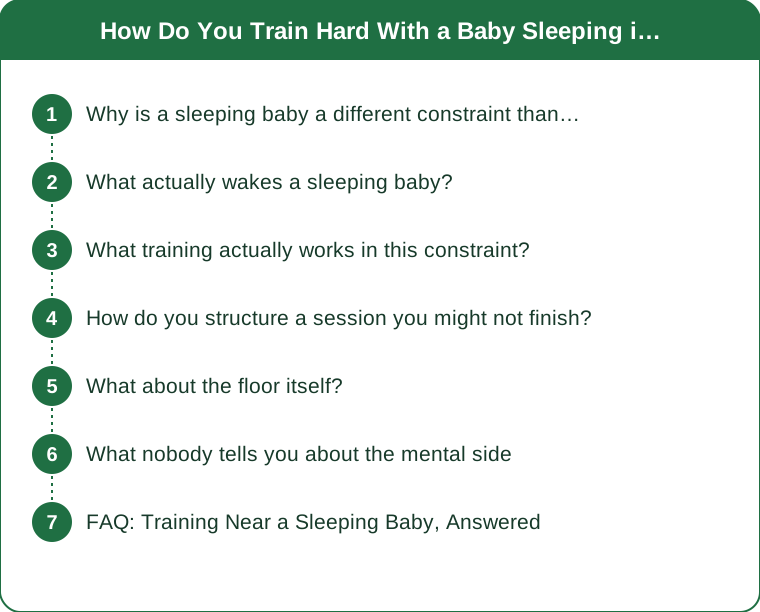
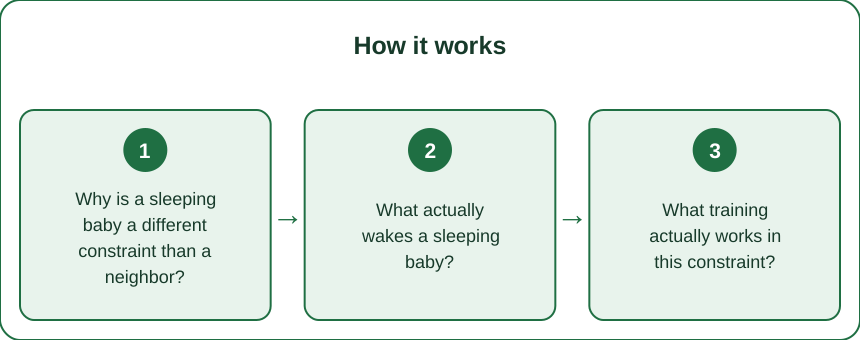
Why is a sleeping baby a different constraint than a neighbor?
Three differences, and each one changes the plan.
The feedback is immediate and expensive. A neighbor might be mildly annoyed and you find out weeks later, if ever. A woken baby costs you the rest of the nap, the workout, and often the next hour. That asymmetry means you optimize for reliability rather than for getting away with it.
The schedule is not yours. Neighbor-friendly training is about avoiding certain hours. Baby-friendly training is about using unpredictable windows that start without warning and end without warning. A 45-minute program is useless if you regularly get 25 minutes.
The sound path is different. A neighbor hears you through floors and walls, so impact and low-frequency vibration are the enemy. A baby in the next room hears you through a shared wall and often a partly open door, so airborne sound — voices, video audio, clattering — matters as much as impact.
That third point is the one most people get wrong. They carefully avoid jumping and then follow a workout video at conversational volume through a laptop speaker three meters from a door.
There is also a fourth factor that has nothing to do with sound: you need to hear the monitor. Any training that raises your own breathing to the point where you cannot hear a stir is training that will run past the moment you needed to stop.
What actually wakes a sleeping baby?
Not steady noise. Babies sleep through remarkably loud continuous sound — washing machines, traffic, white noise machines running at genuinely high levels.
What wakes them is change. A sudden onset, a sharp transient, or an abrupt silence after sustained sound.
This reframes the whole problem. Your goal is not a quiet workout. It is a workout with a flat sound profile — one that starts gently, stays consistent, and ends gently.
In practice that means:
- A dropped or set-down weight is worse than an entire hour of movement. The transient is the problem, not the total.
- Steady controlled reps beat explosive ones, not because explosive is loud but because explosive is uneven.
- Music at a low constant volume is often better than silence, because it raises the floor and masks your own incidental noises. Silence makes every small sound a transient.
- Stopping abruptly can wake them as reliably as starting loudly. Wind down rather than cutting off.
Most people already have a white noise machine running. That is a genuine asset — it raises the masking floor, and it means you have more room than you think as long as everything you do stays smooth.
What training actually works in this constraint?
The good news is that the constraint pushes you toward training methods that are legitimately effective, not toward compromised ones.
Slow tempo bodyweight work. Three seconds down, one second pause, two seconds up. This is silent by nature, and the extended time under tension makes bodyweight movements genuinely hard. A 3-1-2 tempo push-up is a different exercise from a normal push-up, and most people can only do half as many.
Isometric holds. Wall sits, planks, split squat holds, and hollow holds produce zero sound and substantial fatigue. They are underused generally and perfect here.
Resistance bands. Silent, scalable, and they load positions dumbbells cannot. The only noise risk is a band slipping off an anchor, which is both loud and a genuine safety issue — anchor to something solid and check it before loading.
Unilateral work. Split squats, single-leg RDLs, and step-ups load one side with half the total force, which means half the vibration into the floor for the same training effect per leg.
What to avoid entirely: jumping of any kind, dropping or lowering weights to the floor, skipping, burpees, anything explosive, and any exercise that requires you to breathe hard enough to miss the monitor.
What you lose is high-intensity conditioning and heavy loading. What you keep is strength, hypertrophy stimulus, and mobility — which is most of what most people are training for anyway.

How do you structure a session you might not finish?
Assume interruption. Design the session so that stopping at any point still leaves you with something complete.
Use blocks, not programs. Build 8-12 minute blocks that each stand alone. Three blocks make a full session. One block is still a real workout. A 45-minute program abandoned at minute 12 is a wasted 12 minutes and a bad mood.
Front-load what matters. Put the thing you most want to train in block one, always. If you only get one block, you got the important one. This is the opposite of the usual advice to warm up gradually into the main work, and it is the correct adaptation to an unreliable window.
Keep the warm-up inside block one. A separate ten-minute warm-up eats a quarter of your available time. Use the first two sets of the first exercise as the warm-up, at a lighter effort.
Have everything laid out before the nap starts. Mat down, bands out, water there, phone on silent with the workout already open. Setup time is the single biggest thief in a nap-window session, and it happens during the most reliable part of the window.
Set a hard stop with five minutes to spare. Not because the baby will wake exactly then, but because a rushed ending is a loud ending, and you also need a moment to be a functional person before the next shift starts.
A sample structure: Block one, lower body — tempo split squats, band RDLs, wall sit. Block two, upper — tempo push-ups, band rows, plank variations. Block three, whatever you have energy left for. Each block self-contained, each about ten minutes.
What about the floor itself?
Floor treatment matters more here than almost anywhere, and it is the cheapest fix available.
Layer, do not just cushion. A single thick mat compresses and transmits. A mat on top of a rug on top of the floor performs considerably better, because each interface loses energy. The layering matters more than the total thickness.
Train near a wall, not in the middle of a room. Floor joists flex most at their midpoint and least at their supported ends. The same movement produces measurably less vibration near a load-bearing wall.
Know where the shared wall is. If the baby’s room shares a wall with your training space, train against a different wall. This sounds obvious and almost nobody does it — most people train where the space is, not where the sound is not.
Deal with the equipment, not just the exercises. Bands should be hung, not dropped. Dumbbells should be placed and, ideally, never lifted more than a foot off the ground if there is any chance of setting them down quickly. A folded towel where weights get set down absorbs the transient that would otherwise carry.
Check your own feet. Bare feet or thin socks are quieter than trainers on hard floors. Trainers on a mat are fine. Trainers on laminate are a series of small transients.
One test worth doing once: have someone stand in the baby’s room while you run through your session. What you hear in your training space and what carries next door are frequently different, and you will usually discover one specific thing is the whole problem.
What nobody tells you about the mental side
Training in this constraint is harder psychologically than physically, and that is what actually ends most people’s home routines.
You are never fully in the session. Part of your attention is always on the monitor, the door, and the clock. That divided attention makes a 20-minute workout feel longer and less satisfying than a 45-minute one at a gym, even though it may be perfectly effective.
The silence compounds it. Without music you can commit to, without the ambient noise of a gym, and without the ability to breathe hard or make any sound of effort, the work feels more isolating. People consistently report that silent training feels harder at the same objective intensity.
A few things that genuinely help:
- Headphones. One earbud in, monitor audible in the other ear. This restores the psychological benefit of music without raising the room’s sound floor at all. It is the single highest-value change most people can make.
- Count in your head, not on a timer with a beep. Beeping timers are transients.
- Accept the block as the unit of success. Reframing so that one completed block counts as a win rather than as a failed session removes most of the frustration.
- Do not compare it to your old training. It is a different phase with different constraints, and measuring this against a pre-baby gym routine guarantees it looks like a failure.
The consistency is the point. Three 10-minute blocks four times a week beats one heroic session on the weekend, and it is the version that survives contact with an actual baby’s schedule.
How does this change as the seasons close in?
It gets harder in a specific and predictable way, and it is worth planning for now rather than in November.
Windows close. Through summer, open windows let sound escape and ambient outdoor noise raises the masking floor. When windows shut, your training space becomes acoustically live — more reflection, less escape, and every sound carries further. The same session that was inaudible in August is noticeable in October.
Outdoor options disappear. A walk with a stroller, a garden session, or a park block were all pressure valves that removed the noise problem entirely. As the weather turns, everything moves indoors and the constraint applies to your whole training week rather than part of it.
Naps often move indoors and get lighter. A baby who napped in a stroller outdoors now naps in the room next door, which tightens the constraint further.
Practical autumn adjustments: add soft furnishing to the training space if you can — a rug, a throw over a hard surface, anything that reduces reflection. Move the training space if a better-isolated room becomes available. And build the block structure now, while the constraint is still loose, so the habit is established before the harder months arrive.
The people who keep training through winter in this situation are almost always the ones who built the system in September.
FAQ: Training Near a Sleeping Baby, Answered
Is it better to just train after bedtime?
Often yes, if you have the energy — evening training with a baby fully asleep in a dark room is usually more forgiving than a light daytime nap. The tradeoff is that late training can affect your own sleep, which is already the scarce resource. Many people end up doing shorter blocks during naps and saving longer sessions for weekend handoffs.
Do quiet workouts actually build strength?
Yes. Tempo work, isometrics, unilateral loading, and bands all produce genuine strength and hypertrophy adaptation. What you cannot easily do is heavy maximal loading and high-intensity conditioning. For most people that is not the limiting factor in their results.
How do I progress when I cannot add weight?
Slow the tempo, increase the range, reduce the rest, move to a harder unilateral variation, or add a pause at the hardest point. Progression by leverage and tempo works for a long time before you run out of room.
What about postpartum considerations?
Returning to training after birth has real medical considerations — pelvic floor, abdominal separation, and healing timelines — that are individual and not something to guess at. Get cleared and, ideally, get assessed by a pelvic health physiotherapist. Then apply the noise strategies to whatever program you are actually cleared for.
Will a white noise machine let me train louder?
Somewhat, yes. It raises the masking floor, which makes small transients less noticeable. It does not mask a dropped dumbbell, and it does not help with vibration through the floor. Treat it as extra margin, not as permission.
TL;DR:
- A sleeping baby is a different constraint than a neighbor: immediate feedback, an unpredictable window, and airborne sound matters as much as impact.
- Babies sleep through steady noise and wake to sudden change — aim for a flat sound profile rather than for silence, and treat dropped equipment as the real enemy.
- Slow tempo bodyweight work, isometrics, bands, and unilateral loading cover most training goals with zero noise.
- Build 8-12 minute self-contained blocks with the most important work first, so an interrupted session is still a complete one.
- Layer mat over rug, train against a non-shared wall, use one earbud, and set up everything before the nap starts.
- Windows closing in autumn makes your space acoustically livelier — build the system in September, not November.
The version of this that works long term is not the clever exercise selection. It is the block structure and the pre-laid setup, because those are what let you actually start when a window opens unexpectedly. Everything else is refinement on top of showing up in a twenty-minute gap you did not know you were getting.
See It in Motion
Seen here: Maternity Capris with Side Pockets — shop it on bubblelime.com
Keep Reading
This article is for general informational and styling purposes only. Fit, sizing, and product availability may vary.