The Complete Guide to Quiet Workouts in a Rental You Cannot Modify
Quick Answer: In a rental you cannot bolt, drill, or lay permanent flooring — so noise control has to come from where you train, what you stand on, and which movements you choose. The highest-return moves are training over a load-bearing wall or a joist line, stacking a thick mat over a folded blanket over a rug, and replacing every impact movement with a slow tempo equivalent. That combination handles the great majority of complaints without a single permanent change.
The good news is that the permanent solutions were never the effective ones anyway.
The placement of your mat matters more than the flooring under it.
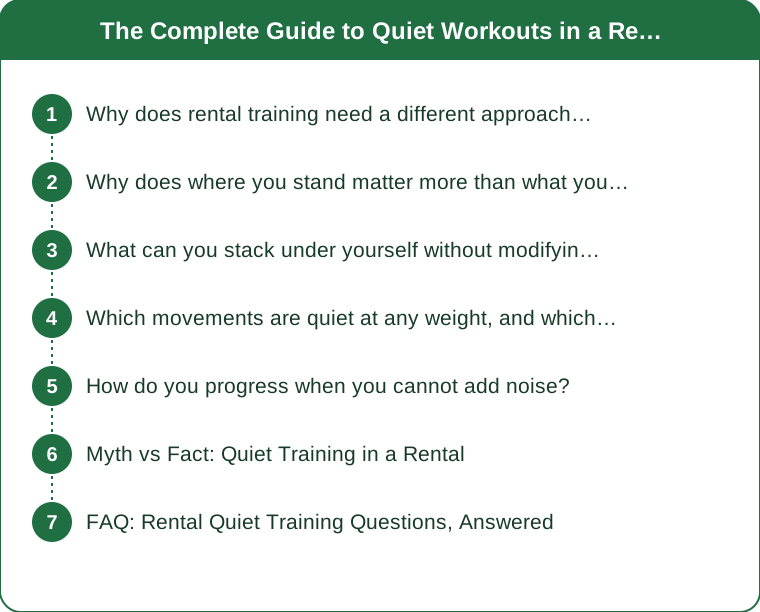
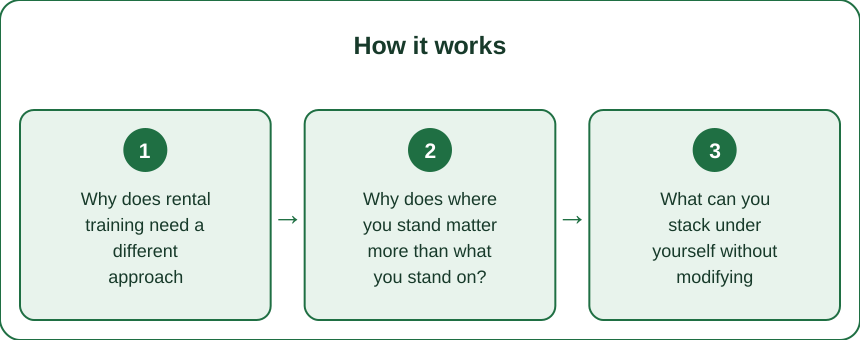
Why does rental training need a different approach entirely?
Because the three standard recommendations are all off the table.
Open almost any guide to apartment training and you will find the same advice: install rubber gym flooring, mount a wall rack, and add acoustic underlay. Every one of those requires either permanent modification or a landlord conversation most tenants would rather not have. Some are explicitly prohibited by standard tenancy terms.
What remains is genuinely different work. You are optimising three variables you do control:
Where you put the mat — which turns out to matter more than what the mat is made of.
What you stack under yourself — using removable, reversible layers.
Which movements you select — because some are quiet at any weight and some are loud at any weight.
The encouraging part is that these three are, in order, the most effective interventions available. Permanent flooring is expensive, disruptive, and further down the list than most people assume. A tenant working within the constraints is not settling for a worse solution; they are being pushed toward the better ones.
Why does where you stand matter more than what you stand on?
Because buildings transmit impact through structure, and structure is not uniform.
When you land from a jump, the force enters the floor and travels through the building’s frame as structure-borne sound. Unlike airborne sound, it is barely affected by soft materials — a mat can absorb some high-frequency slap, but the low-frequency thud that annoys a downstairs neighbour travels through joists and walls regardless.
What does change it is where the force enters. A floor is stiffest where it is supported: directly over a joist, near a load-bearing wall, or in a corner. Land in the middle of a span, between joists, and the floor flexes like a drum skin — which is exactly what it becomes.
Finding the stiff spots without tools:
- Walk the room slowly and feel for where the floor gives underfoot. The bouncy areas are mid-span
- Listen for rattling — glasses in a cabinet, a lampshade. That tells you which floor areas move
- Perimeter areas within about 60cm of a wall are almost always stiffer than the room centre
- If you can see the direction of floorboards, joists usually run perpendicular to them
Moving your mat two metres to a corner or against a wall costs nothing, takes ten seconds, and routinely produces a bigger reduction downstairs than a hundred pounds of flooring in the wrong place.
What can you stack under yourself without modifying anything?
A layered, removable system — and the order matters.
The principle is mass plus damping. A single soft layer compresses and bottoms out under a real landing. Multiple layers of different densities absorb energy at different rates and are far more effective than one thick soft thing.
A stack that works, top to bottom:
- Thick exercise mat, 10 to 15mm. Handles the surface slap and protects your joints
- Folded wool or moving blanket, two or three folds. Adds damping mass and kills the drum resonance
- A dense rug with underlay if you have one, or a second folded blanket
- The existing carpet or floor
Total build height around 40 to 60mm, entirely removable, entirely reversible, and stores in a cupboard.
A few practical notes. Foam interlocking tiles are widely recommended and are mediocre on their own — they are soft, they bottom out, and they do little for low frequencies. In a stack, under a blanket, they are decent. Yoga mats are too thin for anything with impact. And anything you put down should be non-slip, because a stacked surface that shifts underfoot during a lunge is a genuine hazard, not a minor annoyance.
If your building has thin floors and a sensitive neighbour, the stack plus good placement is realistically the ceiling of what you can achieve — and it is usually enough.

Which movements are quiet at any weight, and which never are?
This is where the largest gains live, and it costs nothing at all.
Quiet at effectively any load:
- Slow tempo bodyweight work — squats, lunges, split squats, step-ups at a 3-second lowering
- Isometrics — wall sits, planks, holds at the hardest position
- Band work of every kind. Bands are silent by nature and scale genuinely well
- Floor-based core work performed slowly
- Controlled push-up variations, as long as you lower rather than drop
Loud regardless of technique:
- Jumping of any kind — jump squats, burpees, box jumps, skipping
- Dropping or setting down weights, even gently
- Fast alternating movements like mountain climbers at speed
- Anything where both feet leave the ground
The substitution table is straightforward and the training quality barely suffers:
- Jump squats → 1.5 rep squats or slow tempo squats to failure
- Burpees → squat thrusts with a step back, no jump
- Skipping → fast feet in place on the stack, or a shadow-boxing interval
- Box jumps → step-ups with a slow eccentric
- Mountain climbers → slow plank shoulder taps
The genuine cost is to power development, which needs speed and impact. Everything else — strength, endurance, hypertrophy, conditioning — is achievable quietly. If power work matters to you, that is the one thing worth going outside or to a gym for.
How do you progress when you cannot add noise?
By changing tempo, leverage, and rest instead of load and speed — which is the part most people get stuck on.
A conventional programme progresses by adding weight or reps. Quiet training caps that quickly, because heavy dumbbells in a flat are both loud to set down and awkward to store. So progression has to run on different variables:
Tempo. A squat lowered over 4 seconds with a 2-second pause at the bottom is dramatically harder than the same squat at normal speed, and completely silent. This is the single most useful lever you have.
Leverage. Move from two legs to one. Elevate the front foot. Raise the feet in a push-up. Each of these increases the demand on the working limb without adding a gram.
Range of motion. Deficit split squats, deeper push-ups off a book, full-range single-leg work.
Rest. Cutting rest from 90 seconds to 45 transforms a strength session into a conditioning one.
Unilateral work. Half the load, near-full stimulus per limb, and no equipment needed.
A reasonable structure is to run a movement for four to six weeks, progressing tempo first, then range, then leverage. When you run out of room on one exercise, you move to a harder variation rather than a heavier one.
This is also why quiet programmes plateau differently than gym programmes — the ceiling is real, but it sits much higher than most people reach before they give up. Single-leg tempo work with a pause is difficult for almost anybody.
Myth vs Fact: Quiet Training in a Rental
Myth: A thick mat solves the noise problem
Fact: A mat addresses the sharp slap you hear in your own room and does relatively little for the low-frequency thud your downstairs neighbour hears. Structure-borne sound travels through the building frame. Position and layered mass do far more than any single mat.
Myth: Training barefoot is quieter than in trainers
Fact: Barefoot is quieter for the high-frequency contact sound and no quieter for the impact transmitted into the floor. Cushioned trainers actually help slightly on landings by extending the deceleration. Neither is a solution on its own.
Myth: Morning workouts are the considerate choice
Fact: Early morning is often the worst window, because background noise in the building is at its lowest and shift workers may be asleep. Mid-morning to early evening is typically the least disruptive stretch. If you know a neighbour’s pattern, that beats any general rule.
Myth: If nobody has complained, it is fine
Fact: Most people never complain; they just get quietly annoyed. If you are doing anything with impact in a flat with neighbours below, assume it is audible and act accordingly.
Myth: You cannot build real strength without heavy weights
Fact: You can get remarkably far with tempo, unilateral work, and bands. The genuine limits are in maximal strength and power, not in strength generally.
FAQ: Rental Quiet Training Questions, Answered
What is the single best thing I can do today?
Move your mat to within 60cm of a load-bearing wall, or into a corner. It is free, takes ten seconds, and reliably outperforms every product you could buy.
Are folding treadmills or bikes viable in a rental?
A bike is excellent — quiet, low-impact, transmits very little into the structure. A treadmill is the noisiest common piece of home equipment and transmits both motor vibration and footfall. If you want cardio in a flat, choose the bike or a rower over a treadmill every time.
Should I talk to my neighbours?
A short, friendly heads-up is worth an enormous amount. Telling someone you train for half an hour around 6pm and asking them to say if it is a problem converts a potential complaint into a manageable conversation. Most disputes escalate because nobody spoke first.
Can I use a barbell or heavy dumbbells at all?
Moderate dumbbells are workable if you never set them down from height — lower them to the mat with control every single time. Barbells and any lifting where failure means dropping the weight are not realistic in a flat above someone.
Does the stack damage the carpet?
Not if you lift it after sessions and let the carpet breathe. Leaving a heavy stack in one place for months can flatten pile, which is exactly the sort of thing that gets noticed at a check-out inspection. Roll it up.
This is general information, not legal or tenancy advice. Check your own agreement before making any change to a rented property.
TL;DR:
- The standard advice — rubber flooring, wall racks, acoustic underlay — is unavailable to tenants, and was never the most effective part anyway
- Position beats materials: train near a load-bearing wall, in a corner, or over a joist, never mid-span
- Stack a thick mat over folded blankets over a rug; layered mass beats one soft layer
- Remove impact entirely and progress with tempo, leverage, range, and rest instead
- Mid-morning to early evening is usually the least disruptive window, not early morning
A rental is a real constraint and it is not a disqualifying one. Almost everything that actually reduces noise is free, reversible, and packs into a cupboard — and a friendly conversation with the person below you is worth more than anything you could install even if you were allowed to.
This is general information, not legal or tenancy advice. Always check your own agreement before altering a rented property.
Keep Reading
This article is for general informational and styling purposes only. Fit, sizing, and product availability may vary.