The Complete Guide to Quiet Apartment Workouts When Even Footsteps Travel
Quick Answer: In older or lightweight-construction buildings, the problem often isn’t loudness at all — it’s low-frequency vibration traveling through the floor joists to the unit below, which a standard exercise mat barely addresses since mats are designed to dampen impact sound, not structural vibration. The fix requires decoupling your workout surface from the floor itself, not just cushioning it.
You’ve bought the thickest mat available and the downstairs neighbor still knocks. That’s usually the moment people realize they’ve been solving the wrong problem.

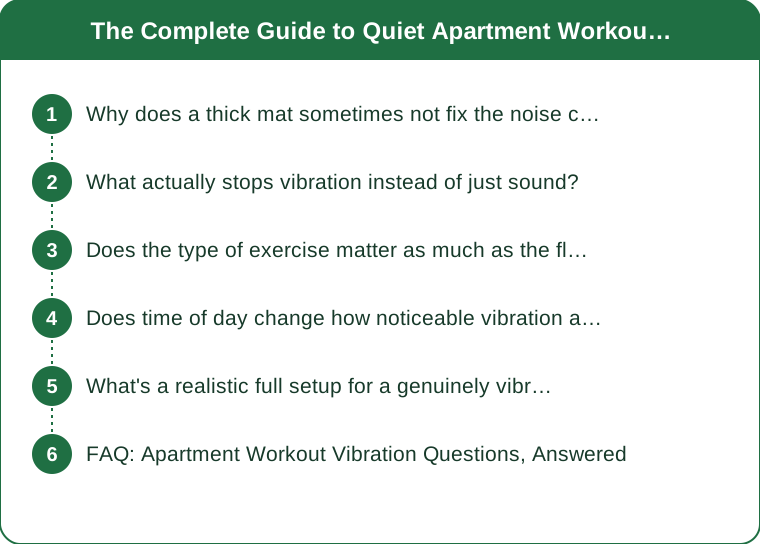
Why does a thick mat sometimes not fix the noise complaint at all?
A standard foam or rubber exercise mat is built to absorb impact sound — the sharp crack of a foot or dumbbell hitting the floor — but it does very little to stop low-frequency vibration from traveling through the building’s structural frame. In lightweight or older wood-joist construction especially, that structural vibration can travel through walls and floor joists to a completely different room downstairs, arriving as a dull thud or hum rather than a sharp noise. Mat thickness helps with the sound you hear; it barely touches the vibration your neighbor feels through their own walls and ceiling.
This distinction matters because it explains a common frustration: someone buys a genuinely good, thick mat, notices their own workout feels and sounds quieter, and yet still gets a noise complaint. The complaint isn’t about what you’re hearing in your apartment — it’s about a different physical phenomenon happening two floors away.
What actually stops vibration instead of just sound?
Vibration isolation requires a decoupling layer between your body of impact and the floor — something with mass and elasticity that absorbs the low-frequency energy before it reaches the structural frame, rather than just cushioning the top layer. Interlocking rubber gym tiles (the kind used in commercial gyms, roughly 3/4 inch thick) do this meaningfully better than a yoga-style mat, because they add real mass and are designed specifically for impact and vibration control, not just surface comfort.
For apartments with a documented vibration issue, stacking two layers — a dense rubber tile as the base layer, with a standard mat on top for comfort — creates a more complete system than either alone. The rubber tile handles the structural vibration; the mat on top handles surface comfort and the sharper impact sounds. This two-layer approach is standard practice in home gym setups built specifically for noise-sensitive buildings, and it’s a meaningfully different investment than just buying a nicer single mat.
Does the type of exercise matter as much as the flooring solution?
Ballistic, high-impact movements (jump squats, burpees, box jumps, heavy dumbbell drops) generate the most structural vibration, regardless of flooring, simply because of the force and speed of impact involved. Even excellent flooring has limits against repeated heavy impact. Substituting lower-impact versions of the same movement — a squat instead of a jump squat, a controlled dumbbell lower instead of a drop, a step-up instead of a box jump — reduces the vibration at the source rather than trying to absorb it after the fact.
This isn’t about avoiding effective exercise; most high-impact movements have low-impact variations that train similar muscle groups with similar intensity, just without the ballistic landing force. Building a workout around these substitutions, especially for the exercises you do most often, addresses more of the problem than flooring investment alone typically can.

Does time of day change how noticeable vibration actually is?
Buildings are generally quieter overall during early morning and late evening hours, which means the same amount of vibration you generate is more noticeable against a quiet ambient baseline than it would be during a busier midday period with more background activity throughout the building. This doesn’t mean vibration itself changes by time of day — it means the contrast against silence does.
For genuinely vibration-sensitive buildings, shifting high-impact portions of a workout to daytime hours when there’s more general building activity (other units, hallway noise, traffic) can meaningfully reduce how disruptive the same movements feel to a downstairs neighbor, even without changing anything about the workout itself.
What’s a realistic full setup for a genuinely vibration-prone apartment?
A complete quiet setup layers three things: a dense rubber tile base (3/4 inch or thicker), a comfort mat on top, and a workout program built mostly around low-impact substitutions for the highest-force movements. This isn’t an all-or-nothing system — even doing two of the three (say, good flooring plus movement substitutions, without eliminating every ballistic exercise) meaningfully reduces the overall vibration transmitted compared to doing none of them.
For apartments where noise complaints have already happened, it’s also worth a direct conversation with the downstairs neighbor about specific times that work best for higher-impact sessions — building relationships this way tends to reduce friction more than any flooring purchase alone, since it turns an anonymous complaint into a solvable, known schedule.
FAQ: Apartment Workout Vibration Questions, Answered
Are rubber gym tiles actually necessary, or is a good mat usually enough?
For genuinely vibration-sensitive buildings (older construction, wood joists, a documented prior complaint), rubber tiles make a meaningful difference beyond what any single mat provides. For buildings with modern concrete construction between units, a good mat alone is often sufficient, since concrete transmits far less vibration than lightweight framing.
How can I tell if my building has a vibration problem versus a normal noise problem?
If a downstairs neighbor describes feeling a thud or hum rather than hearing a sharp sound, or if complaints happen even during quieter, lower-impact workouts, that points toward structural vibration rather than simple airborne noise — which is the case where flooring upgrades matter most.
Does furniture placement affect vibration transmission?
Somewhat — placing your workout area over a load-bearing wall or joist (rather than the center of an open floor span) can reduce how much a given impact travels, since the structure is stiffer and better supported directly above main structural elements.
TL;DR:
- Structural vibration is a different problem from noise, and a standard mat barely addresses it
- Dense rubber gym tiles (3/4 inch+) provide real vibration isolation that thin mats don’t
- Substituting low-impact versions of the highest-force movements reduces vibration at the source
- A layered setup (rubber base + mat + movement substitutions) is more effective than any single fix
A quieter workout in a vibration-prone building isn’t about one better product — it’s a system of three smaller changes working together.
Keep Reading
This article is for general informational and styling purposes only. Fit, sizing, and product availability may vary.