The Complete Guide to Quiet Workouts When Your Neighbor Works Nights
Quick Answer: When a neighbor sleeps during the day, your safe training windows invert — the morning hours everyone recommends become the worst, and mid-evening becomes the best. The fix is a mapped schedule, a training split that puts loud work in the safe windows and silent work in the sensitive ones, and enough floor treatment that the quiet work is genuinely quiet.
Every quiet-workout guide tells you to train early and avoid evenings. That advice is written for a building where everyone is on the same clock. If the person below you gets home at 7am and sleeps until 3pm, following it perfectly makes you the worst neighbor in the building.
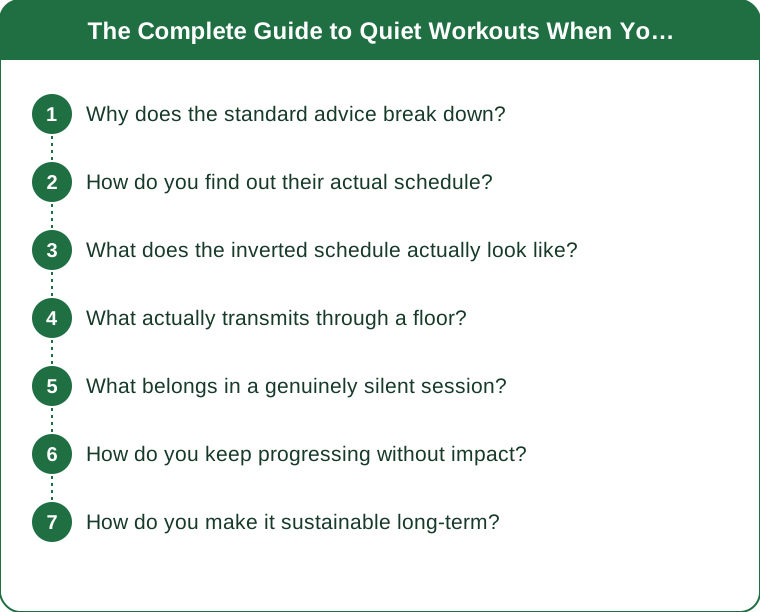
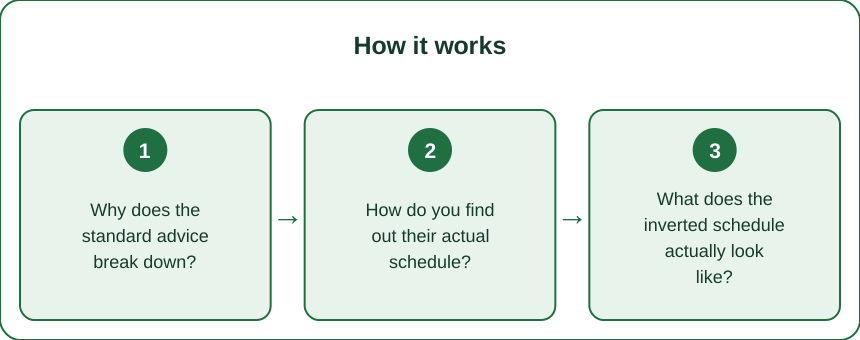
Why does the standard advice break down?
Because it optimizes for the wrong window, and the cost of being wrong is much higher than usual.
The conventional guidance — train between roughly 8am and 9pm, avoid early mornings and late nights — is built on an assumption of shared circadian schedules. Most residential noise ordinances are built on the same assumption, typically defining quiet hours as something like 10pm to 7am.
A night-shift neighbor inverts all of it. Their sleep block might be 8am to 4pm. During those hours:
- The building is otherwise quiet, so your noise has no masking and stands out far more than the same noise at 7pm
- They are in their deepest sleep during exactly the window everyone recommends for morning workouts
- Ambient street noise is low, so structural transmission through the floor is the dominant sound they hear
And there is an asymmetry worth understanding. Daytime sleepers are already fighting for their sleep — daylight, deliveries, traffic, other neighbors. Sleep during the biological day is lighter and more fragmented for physiological reasons, which means the same disturbance costs them more than it would cost a night sleeper.
So this is not a case of applying the normal rules more strictly. It is a case of applying different rules.
How do you find out their actual schedule?
By asking, which is far more effective than any acoustic intervention and is the step people skip because it feels awkward.
A short, specific conversation solves most of this permanently. What to actually ask:
- When do you sleep? Not “do you mind noise” — a specific time block. Most people will happily tell you, and many will name a narrower window than you assumed
- Which days? Night shifts are often four-on, three-off, and their days off may be normal-schedule days. That can free up entire days you thought were restricted
- What do you actually hear? This is the highest-value question. They may hear footfall clearly and music not at all, or the opposite. Guessing wastes effort on the wrong fix
- What is the worst thing? Usually one specific sound — a dropped weight, a particular bass frequency, a jump landing
How to open it without making it a negotiation: mention that you work out at home, that you want to avoid disturbing them, and ask when they sleep. Framing it as you asking for information rather than asking for permission keeps it easy for both of you and gives you something concrete to work with.
If you cannot ask — bad relationship, no contact, or a building where that is not the culture — the observable proxies are reasonably reliable: when their lights are on, when they leave and return, when their car moves. Watch for a week before designing around it.
What does the inverted schedule actually look like?
Once you know the sleep block, mapping is straightforward. Take a typical 8am-to-4pm sleeper:
Green — train freely, including higher-impact work:
- 5pm to 10pm. They are awake and out or awake and up. The building is at its noisiest generally, so you have masking
- Any of their days off, on a normal schedule, following normal quiet-hours rules
Amber — quiet work only:
- 4pm to 5pm. They are up but may still be settling. Fine for controlled strength work, not for jumping
- 10pm to midnight. Standard quiet hours apply for the rest of the building even if this neighbor is out
Red — avoid entirely:
- 8am to 4pm. Their sleep block. This is the one that hurts, because it is the window most home exercisers actually have
- Midnight to 5am. Everyone else in the building
The uncomfortable arithmetic: if you work a standard day job, your green window and their sleep window may barely conflict at all — you are at work during their sleep. The people this genuinely constrains are those who work from home or have flexible hours, and for them the answer is usually to move the session to the evening.
One more variable that helps enormously: find out which direction the sensitivity runs. A neighbor below you hears your floor impacts. A neighbor beside you hears airborne sound and wall contact. A neighbor above you hears very little of what you do. If your night worker is beside you rather than below, jumping is largely fine and dropping a weight against the shared wall is not.

What actually transmits through a floor?
Two different kinds of sound, and they need different fixes — this is the part that determines whether your mat is doing anything.
Impact noise (structure-borne) is created when something strikes the floor. The energy travels through the building structure itself and radiates out of the ceiling below as sound. Footfall, jumping, dropped weights, and a rowing machine’s slide all produce this. It is the dominant problem in apartments and it is the harder one to fix, because a rigid structure carries it efficiently and it barely attenuates over distance.
Airborne noise is sound traveling through air — music, breathing, talking, a fan. It transmits through gaps, thin partitions, and vents, and it is much more readily reduced by mass and sealing.
What this means practically:
- A thin yoga mat does almost nothing for impact noise. It is a comfort layer, not an isolation layer
- What works is decoupling — a resilient layer that absorbs the impact before it reaches the structure. Practically: a high-density rubber mat of about ¾ inch, or interlocking foam tiles doubled up, or a rubber mat over a carpet pad
- Mass helps airborne, decoupling helps impact. They are different jobs and a single product rarely does both well
- The lowest frequencies travel furthest. A dropped dumbbell and a bass-heavy track are heard two floors away when nothing else is
The most cost-effective single purchase for anyone in this situation is a genuine gym-grade rubber mat rather than a foam one. It is heavier, less comfortable, and dramatically more effective.
What belongs in a genuinely silent session?
More than people expect. The constraint rules out impact, not intensity.
Effectively silent, full intensity available:
- Isometrics. Wall sits, planks, split-squat holds, isometric push-up holds. Genuinely hard, genuinely soundless, and underrated for strength
- Slow eccentrics. A five-second lowering phase on a push-up, squat, or row is brutal and makes no noise. Tempo work is the core tool of quiet training
- Band work. Resistance bands produce essentially no impact and cover most pulling and pressing patterns
- Bodyweight strength. Push-ups, split squats, glute bridges, single-leg RDLs, and controlled step-downs
- Mobility, stretching, and controlled core work
Quiet with care:
- Kettlebells and dumbbells, provided you never set them down carelessly. The lift is quiet; the placement is what wakes people
- Low step-ups, if you step down under control rather than dropping
Not quiet, regardless of technique:
- Jumping, skipping, burpees, mountain climbers at speed, and most plyometrics
- Treadmills and rowers, which produce continuous structure-borne noise
The substitution that solves most cardio problems: replace jumping intervals with continuous-tension circuits. Thirty seconds of squat pulses into thirty of an isometric hold into thirty of band work, repeated, produces a heart rate response comparable to interval work with no impact at all. It is harder mentally, because there is no rhythm to hide in, and it works.
How do you keep progressing without impact?
This is where quiet training actually fails for most people, and it is not a noise problem — it is a programming one.
Conventional progression adds load. When you cannot add much load, you have to progress other variables, and most people simply add reps until sets take fifteen minutes and stop being productive.
The variables available to you, roughly in order of usefulness:
- Leverage. Move toward single-limb and longer-lever versions. A split squat is harder than a squat; a single-leg RDL is far harder than a two-leg one; a decline push-up is harder than a flat one. This is the largest untapped lever in bodyweight training
- Tempo. Take a 2-second lowering to 5 seconds and the same exercise becomes materially harder. Add a pause at the hardest point
- Range of motion. Deficit push-ups, a deeper split squat off a low step, a fuller stretch position
- Density. Same work in less time, by shortening rest
- Load, where possible. Bands, a weighted backpack, and adjustable dumbbells all fit in an apartment and make no noise if handled with care
A workable four-week structure: weeks 1 to 3 progress one variable at a time while holding the others constant, week 4 reduces volume. Then change the exercise variation rather than repeating the same progression, because bodyweight movements adapt faster than loaded ones.
The honest expectation: quiet apartment training builds and maintains strength well and builds maximal strength slowly. If maximal strength is the goal, this is a maintenance environment plus a gym, not a replacement for one.
How do you make it sustainable long-term?
By reducing the number of decisions and by keeping the relationship good, because both of those are what actually fail over months.
Fix the schedule once and stop re-deciding. Put your green windows in your calendar as recurring blocks. Every session that requires you to work out whether now is acceptable is a session you are more likely to skip.
Build two named sessions, not a flexible plan. A “green” session that includes impact and a “red” session that is entirely silent. When the window is red, you do not have to redesign anything — you run the other one. This single structure is what keeps quiet-constrained training going past the second month.
Over-invest in the floor once. A proper rubber mat is a one-time cost that removes the anxiety permanently. Anxiety about noise is a bigger drag on consistency than the noise restriction itself.
Keep the relationship warm. Tell them what you changed. A brief “I moved my workouts to evenings, let me know if you ever hear anything” buys enormous goodwill and makes it easy for them to raise a small issue before it becomes a large one. Neighbors who feel considered tolerate far more than neighbors who feel ignored, and that tolerance is worth more than any mat.
Revisit the schedule seasonally. Shift patterns change, people move, and daylight changes when everyone is home. A two-minute check every few months keeps the map accurate.
And know what is out of your hands. In a building with poor floor construction, there is a floor below which you cannot get, and continuing to strip your training back past that point helps nobody. At that stage the conversation is with the building, or the answer is a gym membership for the impact work and home training for everything else. That is a legitimate solution, not a failure.
TL;DR:
- A night-shift neighbor inverts the standard schedule — their 8am-to-4pm sleep is your red zone, evenings are green
- Ask directly about their sleep block, their days off, and what they actually hear; it beats every acoustic fix
- Impact noise needs decoupling (thick rubber), airborne noise needs mass — a thin yoga mat solves neither
- Isometrics, slow eccentrics, and band work give you full intensity with zero impact
- Progress leverage, tempo, and range rather than load, and build two named sessions so you never have to redesign
The constraint is real and it is workable. What makes it hard is not the noise limit — it is the daily uncertainty about whether right now is okay. Map the windows once, treat the floor once, and the whole thing becomes background.
Keep Reading
This article is for general informational and styling purposes only. Fit, sizing, and product availability may vary.