Complete Guide to Quiet Training When You Share a Wall With a Bedroom
Quick Answer: Floor noise travels as impact vibration through the structure and is solved with mass and isolation underfoot. Wall noise is mostly airborne - your breathing, music, equipment rattle, and voice - plus anything that physically touches the shared wall. So mats and rubber tiles, which fix the downstairs problem, do very little for the neighbour beside you. The wall fixes are different: move everything away from the wall, kill airborne noise at the source, and treat contact points.
This guide covers what actually transmits through a wall, how to test it, and a full quiet programme that respects a bedroom on the other side.

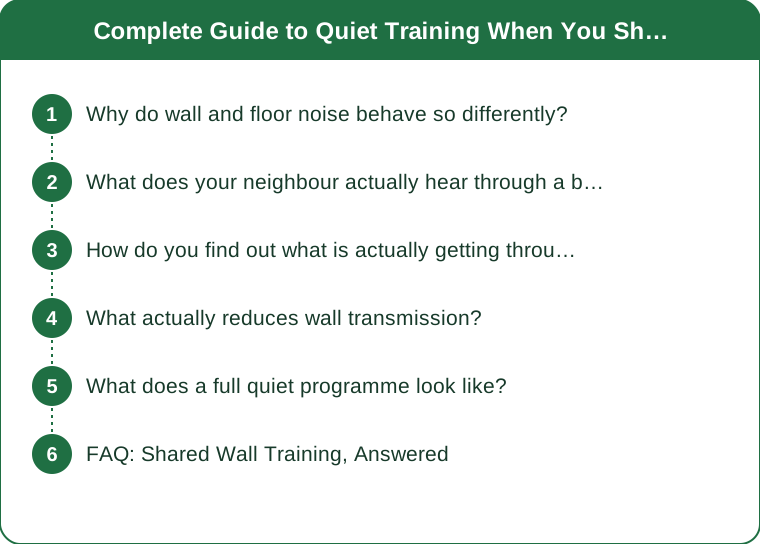
Why do wall and floor noise behave so differently?
Because they travel by different routes, and each route has its own fixes.
Floor noise is structure-borne impact. A jump, a dropped weight, or a heel strike sends a vibration pulse into the floor slab. That vibration travels through the building structure and re-radiates as sound in the room below - which is why the downstairs neighbour hears a thud rather than a noise. Mass and resilient isolation under the impact point are what interrupt it.
Wall noise is mostly airborne. Sound waves in your room strike the wall, make it vibrate slightly, and that vibration re-radiates as sound on the other side. Your breathing, a fan, music, the rattle of a resistance band, and your voice all travel this way.
Frequency behaves differently in each case. Impact noise is dominated by low frequencies, which travel far through structure and are extremely difficult to block. Airborne noise covers a wider range, and the higher frequencies are much easier to reduce - which is why airborne fixes tend to produce noticeable improvement while impact fixes need mass to do anything at all.
Then there is the contact route, which is the one people miss entirely. Anything physically touching the shared wall transmits vibration directly into it, bypassing the air. A dumbbell rack against the wall, a resistance band anchored to a door frame, a treadmill with its frame touching the plasterboard - each turns the wall into a speaker.
And walls in most modern apartments are far worse than floors. A stud wall with plasterboard on each side is a lightweight partition, and lightweight partitions block sound poorly compared with a concrete slab. So the wall neighbour often hears more than the floor neighbour, from a much smaller source.
The practical consequence: the rubber mat you bought for the downstairs neighbour is doing very little for the person sleeping on the other side of your wall. You need a different set of interventions, and fortunately most of them are free.
What does your neighbour actually hear through a bedroom wall?
Ranked by how commonly it is the real culprit.
Anything touching the wall. The single biggest source. Equipment, furniture supporting equipment, a mat that touches the skirting, a band anchored to the door. Direct contact bypasses air entirely and transmits far more energy than airborne sound.
Music and video. Bass in particular. Low frequencies pass through lightweight walls very effectively and are the most common complaint in apartment buildings generally. Your workout playlist is probably louder next door than your workout.
Breathing and vocalisation. Heavy breathing, exhaling forcefully, and the involuntary grunt at the end of a hard set. In a quiet bedroom at night, these are clearly audible through a stud wall - and they are the noise people are least aware they are making.
Equipment noise. Resistance band snap, the click of adjustable dumbbells, a squeaking mat, the rattle of a suspension trainer anchor. Sharp transient sounds are more noticeable than continuous ones, even at lower volume, because the ear is drawn to change.
Footfall near the wall. Even in a controlled workout, stepping close to a shared wall transmits more than stepping in the middle of the room.
And the timing multiplier that dominates everything: the same noise at 6am in a bedroom is far more disruptive than at 6pm. A neighbour who works nights or has a young child has a completely different tolerance, and no amount of technical mitigation substitutes for knowing the schedule on the other side.
What they mostly do not hear through a wall: your jumping, if it is well away from the wall. Jump impact goes into the floor, which is the downstairs neighbour’s problem, not the side neighbour’s. This is the most common misallocation of effort in apartment training.
How do you find out what is actually getting through?
Test rather than guess - the answers are usually surprising.
Ask, if you can. By far the most efficient method. A neighbour will tell you exactly what they hear and when, and the answer is frequently something you never suspected - often the music or a specific piece of equipment rather than the exercise.
The phone test. Leave a phone recording in the room on the other side of the wall if you have access - a neighbour’s hallway, or your own room if the shared wall is internal. Do your normal session, then listen back. Recordings reveal what habituation hides, because you have stopped hearing your own noise.
The touch test. Put your palm flat on the shared wall while a piece of equipment is in use. If you can feel vibration, that vibration is being radiated as sound on the other side. This finds contact-route problems instantly and it takes ten seconds.
Isolate variables. Do one exercise at a time with the music off. Most people discover the offending noise is not the exercise at all - it is the fan, the playlist, or the band anchor.
Check the flanking paths. Sound also travels through shared ductwork, around the edges of a wall, through electrical outlet boxes, and under doors. Back-to-back electrical sockets in a stud wall are a notorious weak point, and stuffing mineral wool behind the faceplate is a genuine, cheap improvement.
And check the wall’s construction, roughly. Knock on it. A hollow sound means a stud partition - lightweight, easily excited, and where most of these problems live. A solid sound means masonry, which is far better and shifts the priority almost entirely to airborne sources and contact points.

What actually reduces wall transmission?
In order of effect per unit of effort and cost.
1. Move everything away from the wall. Free, immediate, and the highest-value change available. Train in the middle of the room and keep at least a couple of feet between you, your equipment, and the shared wall. No mat, no equipment, no anchor touching it.
2. Kill the music, or use headphones. Bass through a stud wall is the most common complaint in apartment living, and headphones eliminate the entire category in one step. This is the second-highest-value change and it costs nothing if you already own headphones.
3. Put mass against the wall. A full bookshelf, a wardrobe, or a heavy sofa adds mass and breaks up the wall surface, which reduces transmission meaningfully. Furniture is far more effective than acoustic foam, which addresses echo within your room and does almost nothing for transmission. This distinction wastes a great deal of money every year.
4. Treat the contact points. Felt pads under equipment, nothing anchored to the shared wall or its door frame, and a mat that does not touch the skirting board. Any hard object bridging your floor to the wall is a direct transmission path.
5. Deal with breathing noise by changing the work. Sustained isometric and slow-tempo work produces far less heavy breathing than intervals. This is a programming change, not an acoustic one, and it is the only real fix for vocalisation.
6. Seal the gaps. Under the door, around outlet plates, at skirting boards. Sound leaks through small openings disproportionately, and draught excluders are cheap.
What is not worth it in a rental: acoustic foam panels (wrong problem entirely), thin mass-loaded vinyl (needs proper installation to do anything), and anything requiring you to build a second wall. The genuine solutions to wall transmission are structural, expensive, and not available to most renters - which is why the behavioural fixes above matter so much more.
What does a full quiet programme look like?
Built around low-noise movement patterns, and genuinely effective as training.
Lower body: tempo squats, split squats, and step-ups. Slow eccentric - three to five seconds down - with a pause at the bottom. Slow tempo increases time under tension substantially, which is how you generate a training stimulus without load or speed.
Single-leg work throughout. Split squats, single-leg deadlifts, single-leg glute bridges. A single-leg variation roughly doubles the load on the working leg without adding weight, jumping, or noise - the most efficient answer to the quiet-training problem.
Upper body: push-ups with tempo variations, band rows, and controlled dips. Bands are near-silent if the anchor is not on the shared wall - anchor to a heavy piece of furniture or under a door on the opposite side.
Isometrics for intensity without movement. Wall sits, planks, split-squat holds, isometric push-up holds. Genuinely demanding and completely silent, and they are the answer when you want a hard session late at night.
Core: dead bugs, bird dogs, side planks, hollow holds. All floor-based, slow, and quiet - and floor work is inherently low-noise as long as you are not near the wall.
Conditioning without jumping: shadow boxing, fast step-ups, mountain climbers with controlled feet, and bodyweight circuits with short rests. Elevated heart rate comes from density - shorter rests - rather than from impact.
Programming for progression, which is the real challenge. Quiet training plateaus because you cannot easily add load. The available progressions are: slower tempo, longer holds, greater range of motion, harder single-limb variations, less rest, and more sets. Work through them deliberately in that order rather than adding reps indefinitely - rep creep is why quiet programmes stall at around six weeks.
And schedule around the bedroom, not around yourself. The most effective noise mitigation available is training when nobody is sleeping on the other side. A session moved from 6am to 9am solves more than any equipment purchase, and it is worth asking rather than assuming.
This is general fitness information, not medical advice. If you have joint problems or are returning from injury, tempo and isometric work is generally well tolerated but worth discussing with a professional first.
FAQ: Shared Wall Training, Answered
Why does my rubber mat not help my next-door neighbour?
Mats address impact vibration going into the floor, which is the downstairs neighbour’s problem. Wall transmission is mostly airborne plus direct contact, and a mat addresses neither.
What is the single most effective change?
Move everything - you, your mat, your equipment - away from the shared wall, and use headphones instead of speakers. Both are free, and together they eliminate most of what a wall neighbour actually hears.
Does acoustic foam help?
Not for transmission. Foam reduces echo within your own room. To reduce sound passing through a wall you need mass, which is why a full bookshelf against the wall outperforms a wall of foam panels.
Can my neighbour hear me breathing?
Through a lightweight stud wall in a quiet bedroom, quite possibly. Heavy breathing and involuntary grunting are among the noises people are least aware of making, and they are best addressed by choosing slower-tempo work.
Is jumping actually the problem?
For the downstairs neighbour, yes. For the side neighbour, much less so - jump energy goes into the floor. Effort spent eliminating jumping for a wall neighbour is usually misdirected.
How do I test what is getting through?
Record on a phone in the adjacent space if you can, put your palm flat on the wall to feel for vibration during exercise, and isolate one variable at a time with the music off. And ask the neighbour - it is by far the fastest route to the real answer.
Why does my quiet programme stop progressing?
Because you cannot easily add load. Progress instead through slower tempo, longer holds, greater range, harder single-limb variations, and shorter rests - in that order, rather than simply adding reps.
TL;DR:
- Floor noise is impact vibration; wall noise is airborne plus direct contact. Mats fix the first and do very little for the second.
- The biggest wall culprits: anything touching the wall, music (especially bass), heavy breathing, equipment rattle, and footfall near the wall.
- Jumping is mostly the downstairs neighbour’s problem, not the side neighbour’s - effort spent eliminating it for a wall neighbour is usually misdirected.
- Highest-value fixes, all free: move everything away from the wall, use headphones, put a full bookshelf or wardrobe against the wall.
- Acoustic foam does not reduce transmission - it reduces echo in your own room. Mass does the work.
- Test it: record on a phone next door, feel the wall with your palm during exercise, isolate one variable at a time - and just ask.
- Programme around tempo work, single-leg variations, isometrics, and band work anchored away from the wall.
- Progress by tempo, holds, range, single-limb variations, and shorter rests - in that order. Rep creep is why quiet programmes stall around week six.
The most effective noise mitigation is scheduling. A session moved from 6am to 9am beats any equipment purchase.
This is general information, not medical advice.
Keep Reading
This article is for general informational and styling purposes only. Fit, sizing, and product availability may vary.