The Complete Guide to Quiet Training When Your Whole Building Works From Home
Quick Answer: When neighbors work from home, there is no longer a safe window — every hour is potentially someone’s meeting. The workable approach is to shift from timing-based noise management to source-based noise management: eliminate impact entirely, control the floor, manage the sounds you forget about (dropped equipment, breathing, video audio), and reserve the loudest work for the narrow windows that still exist. This guide covers each source, what to substitute, and how to keep progressing without impact work.
The constraint is real, and it is more workable than it first appears.
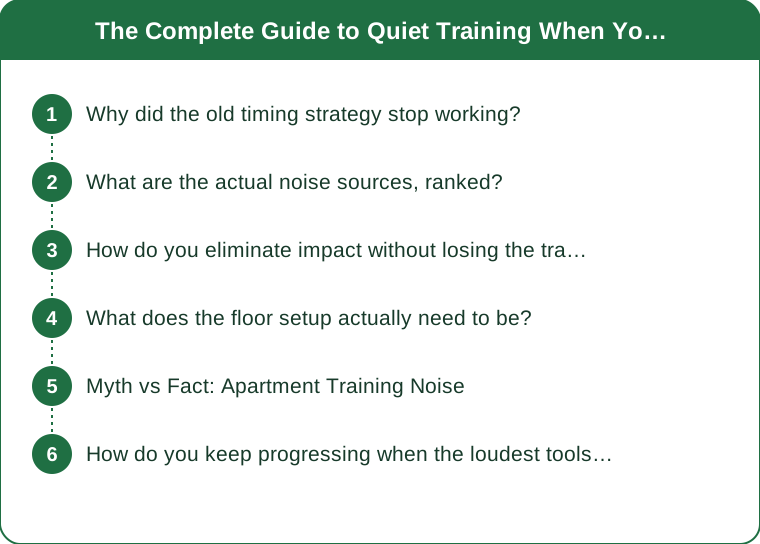
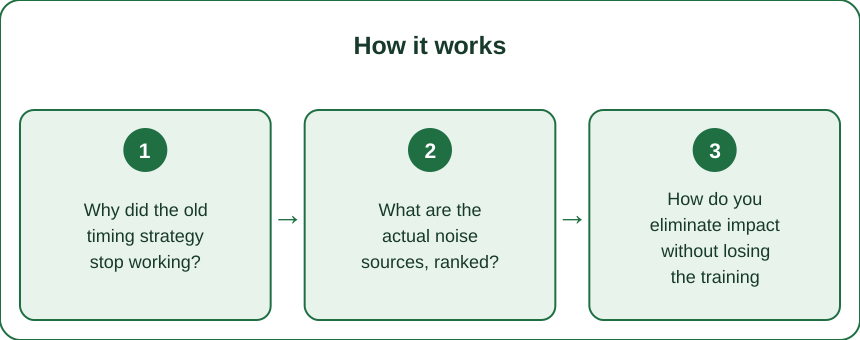
Why did the old timing strategy stop working?
Because the assumption underneath it disappeared.
The traditional advice for apartment training was straightforward: exercise between roughly 9am and 5pm on weekdays, when the building is empty. Avoid early mornings and late evenings. Weekend mornings are risky.
That advice assumed the building emptied during the day. In a building where a substantial share of residents work from home, the daytime hours are now the most sensitive hours, not the least. A 2pm session that would have been invisible five years ago now lands in the middle of someone’s call.
The change is worse than a simple shift, because the sensitive activity is different. Sleep is disturbed by loud, sudden noise. Video calls are disturbed by any noise the microphone picks up, which includes rhythmic low-frequency sound that a sleeping person would never notice. A neighbor doing jump rope overhead does not wake anyone at 2pm. It does put a thudding rhythm into a work call.
There is also a social dimension. Someone woken at 6am has a clear complaint. Someone whose meeting was slightly disrupted at 2pm usually says nothing and develops a quiet resentment, which is arguably a worse outcome because it never gets negotiated.
The practical consequence: you can no longer solve this with scheduling alone. You have to solve it at the source. The good news is that source-based solutions work at any hour, which means you get your schedule back.
What are the actual noise sources, ranked?
There are six, and most people only think about the first one.
One: impact through the floor. Jumping, running in place, burpees, jump rope, dropped weights. This is structure-borne noise — it travels through the building frame rather than the air, which is why it is heard three floors away and why closing a window does nothing. It is by far the largest problem and the only one that is genuinely unsolvable by mitigation. It has to be eliminated or substituted.
Two: equipment contact. Setting a dumbbell down, a kettlebell touching the floor, a bench sliding, a resistance band anchor thumping against a door. These are individually brief and collectively constant, and they are the most fixable category.
Three: the floor itself under load. Older buildings have floors that flex and creak. A lunge or a single-leg movement can produce a creak that carries, even with no impact at all. This one surprises people because they were being careful.
Four: audio. Workout videos, music, and the coaching voice on an app. This is airborne noise and it travels through walls readily, particularly bass. Headphones solve it completely and are the least-used solution.
Five: your own breathing and effort noise. Real, and lower on the list than people assume. Heavy breathing does not travel through a wall. A loud exhale on a hard rep can, in a thin-walled building.
Six: furniture and setup noise. Moving a coffee table to clear space, unrolling a mat, dragging a chair. This happens at the start and end of every session and is often the loudest part of the whole thing.
Sources two, three, four, and six account for most complaints in buildings where the resident has already stopped jumping. They are also the ones nobody addresses, because the mental model is that noise equals impact.
How do you eliminate impact without losing the training effect?
By substituting the training quality rather than the exercise.
The mistake is to look for a quiet version of a jump. There usually is not one. The better approach is to ask what the jump was training and find another route to it.
For cardiovascular conditioning, the substitutes are excellent. Circuits of controlled bodyweight movements with short rest — squats, lunges, push-ups, rows, glute bridges — raise heart rate as effectively as jumping when the rest is short enough. The limiting factor is usually that people rest too long, not that the exercises are insufficient.
Isometric holds are underrated here. A wall sit, a plank, or a split squat hold produces a substantial cardiovascular demand with zero floor contact noise, because the tension itself is metabolically costly.
For power and explosiveness, this is the genuine loss, and it is partial. You cannot train jumping without jumping. You can train the underlying qualities — rate of force development through fast concentric intent on controlled movements, and eccentric strength through slow lowering. A squat performed with maximal intent to move fast, even when the load makes the actual movement slow, trains a meaningful part of what a jump trains.
For running-specific fitness, the honest answer is that indoor substitutes are imperfect and outdoor running is the solution. Treadmills in apartments are among the loudest possible options.
For strength, there is essentially no loss. Slow, controlled resistance work is inherently quiet, and it is also the most effective way to build strength. The quiet constraint pushes you toward tempo work, longer time under tension, and unilateral exercises, all of which are things most programs should include more of anyway.
That last point is worth sitting with. A quiet program is not a compromised program. It is a program weighted toward strength, control, and endurance and away from plyometrics — which for most people training for general health is the better weighting regardless of neighbors.
What does the floor setup actually need to be?
Three layers, and the order matters.
A dense base layer is what stops structure-borne sound. Standard foam mats are designed for comfort and grip, and they do very little for noise transmission because foam is light. What works is mass and decoupling — rubber gym flooring, horse stall mats, or dense rubber tiles. Thickness matters less than density.
A middle absorbing layer helps for dropped equipment. A folded moving blanket or a carpet remnant under the mat absorbs the sharp transient of something being set down.
The top layer is your normal mat, for grip and comfort.
This stack meaningfully reduces equipment noise and floor creak. It does not solve jumping, and it is important to be honest about that — no reasonable domestic flooring stops impact from a jump traveling through a building frame. Marketing that suggests otherwise is selling comfort as isolation.
Beyond flooring:
Position matters. Training near a load-bearing wall transmits less than training in the center of a floor span, because the floor flexes least at its supports. If your apartment has an obvious creaky zone, it is usually mid-span, and moving your mat six feet can make a real difference.
Set equipment down, do not place it down. Actually lowering a dumbbell with control to the mat rather than releasing it from six inches removes most equipment noise. This is a habit, not a purchase.
Use adjustable dumbbells or a single pair rather than a rack. Every plate change is a noise event, and the fewer transitions, the quieter the session.
Bands over weights where the exercise allows. Resistance bands are silent by nature and cover a large share of upper body work. The one caveat is the anchor point — a band anchored in a door will thump the door on every rep unless you pad it.
Myth vs Fact: Apartment Training Noise
Myth: A thick foam mat makes jumping acceptable. Fact: Foam mats reduce the sound in your own room and do very little for what travels through the structure. The neighbor below hears nearly as much. Mass, not softness, is what attenuates structure-borne noise.
Myth: If I cannot hear it, they cannot hear it. Fact: Structure-borne sound travels differently than airborne sound and can be louder in an adjacent unit than in your own room. Low-frequency impact in particular is often more audible below you than to you.
Myth: Bodyweight training is inherently quiet. Fact: Burpees, mountain climbers, and jumping lunges are bodyweight and among the loudest things you can do. The category is not the issue; impact is.
Myth: Training during the day is always safer. Fact: In a building with substantial work-from-home occupancy, midday is often the most sensitive window because of calls. Early evening, after the workday and before quiet hours, is frequently the best window now.
Myth: Neighbors will tell you if it is a problem. Fact: Most people never complain and simply become annoyed. The absence of a complaint is weak evidence, which is why source-based solutions are worth doing proactively.
Myth: You cannot get a real workout without impact. Fact: Impact training is one narrow quality among many. Strength, muscular endurance, cardiovascular fitness, and mobility are all fully trainable without a single jump.
How do you keep progressing when the loudest tools are off the table?
By using the progression variables that do not add noise, which turn out to be most of them.
Tempo is the first and most powerful. A squat with a four-second lowering phase, a one-second pause, and a controlled rise is dramatically harder than the same squat at normal speed, with identical equipment and zero added noise. Progressing from a 2-0-2 tempo to a 4-1-2 tempo over a few weeks is a genuine progression.
Range of motion is second. A deficit push-up with hands on books, a split squat with the rear foot elevated, a deeper squat — all increase difficulty without load or impact.
Unilateral progression is third and often the most useful in a small space. Moving from a two-leg squat to a split squat to a rear-foot-elevated split squat to a pistol progression covers an enormous strength range with no equipment at all.
Density is fourth. The same work in less time. Reducing rest from 90 seconds to 60 across a training block is a real progression and it costs nothing.
Then load. Adding weight when you have one pair of dumbbells means increasing reps, then tempo, then moving to a harder unilateral variation, then finally adding the next weight.
Isometric holds fill the gap where load is unavailable. When you have outgrown your heaviest dumbbell on a movement, adding a five-second pause at the hardest position restores the challenge immediately.
A workable weekly structure under these constraints: two strength sessions built on tempo and unilateral work, one circuit session for conditioning using short rests and isometrics, and outdoor walking or running for the cardiovascular work that indoor training does least well. The outdoor component matters more here than in an unconstrained program, because it is where the impact and the higher-intensity cardiovascular work go.
And on timing, the residual advice for a work-from-home building: early evening, roughly 5:30 to 7:30pm, is usually the safest window now — the workday is over, calls have stopped, and it is well before quiet hours. Weekend mid-mornings are also generally fine. Those windows are where any remaining borderline work should go.
This is general training information, not medical advice.
TL;DR:
- Timing-based noise management stopped working when neighbors started working from home — midday is now often the most sensitive window.
- Impact is the only unsolvable source; equipment contact, floor creak, audio, and setup noise are all fixable and are what most complaints are actually about.
- Dense rubber flooring beats thick foam, because mass rather than softness attenuates structure-borne sound.
- Progress with tempo, range of motion, unilateral variations, and density — a quiet program is weighted toward strength and control, which most people need more of anyway.
Start with the flooring stack and the set-it-down-gently habit. Those two remove most of the noise you are actually making, at any hour.
Keep Reading
This article is for general informational and styling purposes only. Fit, sizing, and product availability may vary.