Why Training Quietly Changes What You Can Train - and What to Do About It
Quick Answer: Quiet training removes impact, ballistic movement and heavy drops. Strength, hypertrophy, mobility and most cardiovascular work survive that fine - tempo work, isometrics, unilateral loading and step-ups cover them. What genuinely suffers is power development, maximal loading and high-impact bone loading. Replace those with tempo eccentrics, heavy isometrics and one or two weekly sessions outside the apartment rather than pretending they are not missing.
Everything you read about apartment workouts is a list of quiet exercises.
Almost nothing tells you what you lost, which is the part that matters for programming.
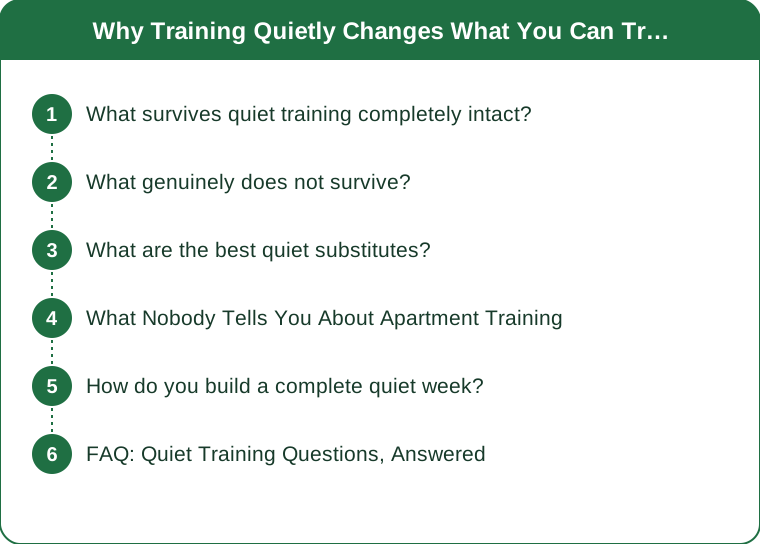
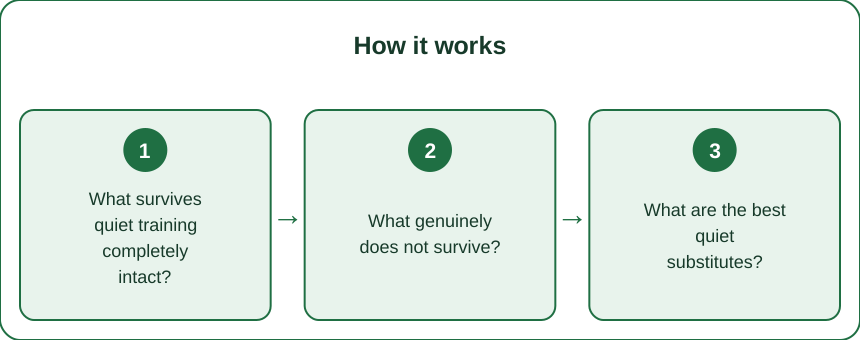
What survives quiet training completely intact?
Strength and hypertrophy, almost entirely. Muscle responds to mechanical tension and time under tension, neither of which requires noise.
Tempo work is quiet by nature - a four-second lowering is silent, and it is an excellent hypertrophy stimulus.
Isometrics are completely silent and are strongly supported for building strength at the joint angles trained.
Unilateral work makes moderate loads feel heavy, which is exactly what you need when you cannot own heavy weights. A single-leg squat needs far less load than a two-leg one.
Mobility and flexibility work is unaffected in every respect.
And steady-state cardiovascular work survives through marching, step-ups on a sturdy box, shadow boxing and low-impact circuits - all of which can sustain a heart rate without a single jump.
What genuinely does not survive?
Power and rate of force development. Jumping, throwing and sprinting are the primary tools, and quiet versions are poor substitutes.
Maximal loading. Without heavy weights you cannot train in the very low rep ranges that build maximal strength, and there is no clever bodyweight workaround for it.
High-impact bone loading, which is relevant for bone density and which specifically requires impact. Walking and resistance work help, but impact is the strongest stimulus.
High-speed movement generally, including agility and change of direction.
These are real gaps rather than things to reframe. The honest response is to acknowledge them and to plan around them.
Which usually means one or two sessions a week outside the apartment - a gym, a park, a stairwell - covering exactly the qualities the quiet program cannot.
What are the best quiet substitutes?
Tempo eccentrics for strength: four seconds down, one second up, on squats, push-ups, split squats and rows. Silent, and a strong stimulus.
Isometric holds for maximal strength: a wall sit at a specific angle, a mid-range push-up hold, an isometric split squat. Push hard for 10 to 30 seconds. Heavy isometrics build strength effectively at and near the trained angle.
Unilateral loading for intensity: Bulgarian split squats, single-leg hinges, single-arm rows. These make a light dumbbell feel appropriately heavy.
Bands for everything horizontal, which are silent, cheap and provide accommodating resistance that increases through the range.
Step-ups on a sturdy chair for cardiovascular work, which sustain heart rate without impact.
A thick mat under everything, which is the single most effective equipment purchase for quiet training - it removes most of the residual noise and makes floor work far more pleasant.
And slow controlled tempo everywhere, which is both quieter and generally a better stimulus than fast repetitions.
What Nobody Tells You About Apartment Training
Most noise complaints are about vibration, not sound. Impact transmits through the building structure, which is why a jump is a problem and a shout is not. A thick mat addresses the transmission mechanism directly.
Dropping a dumbbell once is worse than an entire hour of quiet work. Neighbour relations are shaped by peak events, not by averages, so the single most valuable rule is to never let a weight touch the floor uncontrolled.
Time of day matters more than exercise selection. The same session at 7am and at 9pm produces completely different reactions. Most quiet noise complaints are timing complaints.
Isometrics are drastically underrated in general, not only in apartments. They build strength effectively, require no equipment, and are the most schedule-flexible training there is.
Bodyweight training plateaus faster than people expect for lower body, because legs are strong relative to body weight. Unilateral variations are the fix, and they are the step most home programs skip.
A doorway pull-up bar is the highest-value quiet purchase after a mat, since vertical pulling is the hardest pattern to replicate without equipment.
And talking to your neighbours first solves more than any amount of quiet technique. A thirty-second conversation about when you train pre-empts nearly every complaint that would otherwise arrive as a note.
How do you build a complete quiet week?
Three strength sessions: one push-focused, one pull-focused, one lower-body, all with tempo and unilateral work.
Two cardiovascular sessions: step-ups, brisk outdoor walking, cycling or a low-impact circuit.
One mobility session, or ten minutes daily.
One session outside the apartment weekly if possible, covering the gaps - heavy loading at a gym, or hill sprints and jumps at a park.
Progress through tempo, then range, then unilateral, then load - which is the progression ladder when you cannot simply add plates.
Add a heavy isometric to each session as the closest available substitute for maximal work.
And be honest in the log about what you are not training, so that the gaps are a decision rather than an oversight. This is general information, not medical advice.
FAQ: Quiet Training Questions, Answered
Can you build real strength without heavy weights?
Substantially, yes - through tempo, unilateral loading and isometrics. Maximal strength in very low rep ranges is the part that genuinely requires heavy load.
Are isometrics as good as regular reps?
For strength at and near the trained joint angle, they are highly effective. They are less effective for hypertrophy across a full range, so use both.
How do I do cardio without jumping?
Step-ups on a sturdy box, marching in place with high knees, shadow boxing, and brisk outdoor walking all sustain heart rate without impact.
What is the best single purchase for quiet home training?
A thick exercise mat. It addresses vibration transmission, which is what neighbours actually notice, and it makes floor work far more pleasant.
Will I lose bone density without impact?
Impact is the strongest stimulus for bone, but resistance training and walking both contribute meaningfully. If bone density is a concern, discuss it with a clinician and consider adding impact work outside the home. This is general information, not medical advice.
How do I keep progressing without adding weight?
Progress tempo first, then range of motion, then move to unilateral variations, then add load. That ladder covers a long time before equipment becomes the limiter.
TL;DR:
- Strength, hypertrophy, mobility and steady cardio all survive quiet training essentially intact.
- Power, maximal loading and high-impact bone loading genuinely do not - name the gap rather than reframing it.
- Tempo eccentrics, heavy isometrics and unilateral loading are the three substitutes that do the most work.
- Most complaints are about vibration, not sound - a thick mat addresses the actual mechanism.
- One dropped dumbbell outweighs an hour of quiet work; never let a weight touch the floor uncontrolled.
- Progress tempo, then range, then unilateral, then load.
One weekly session outside the apartment covers what the quiet program cannot. This is general information, not medical advice.
Keep Reading
This article is for general informational and styling purposes only. Fit, sizing, and product availability may vary.