A Quiet Full-Body Workout (No Jumping, No Noise, All Effort)
Quick Answer: You can get a genuinely hard full-body workout with zero jumping by using slow tempo — 3 seconds down, 1 second up — plus isometric holds and single-leg work. Eight moves, 40 seconds each, 3 rounds, about 25 minutes. Add a 6mm+ mat and keep your footwork deliberately soft, and nothing transmits through the floor. Intensity comes from time under tension, not impact.
Apartment living has one specific fitness problem: the downstairs neighbor.
Burpees at 7am are a declaration of war. Jump squats at 9pm are worse. So people either give up on home workouts or do them apologetically at half effort, which is its own kind of pointless.
Here’s the thing though — noise and intensity are unrelated. The hardest thing you can do to a muscle is put it under tension for a long time, and tension is completely silent.
Can a No-Jumping Workout Actually Be Hard?
Yes — and in some ways harder.
Jumping is fast, which means momentum does part of the work and each rep spends relatively little time under load. A jump squat might put your quads under real tension for half a second per rep.
A slow tempo squat — 3 seconds lowering, 1 second pausing at the bottom, 1 second up — keeps them loaded for 5 seconds per rep. Ten reps is 50 seconds of continuous tension versus maybe 5 seconds from ten jump squats.
Time under tension is one of the better-established drivers of muscular adaptation, which is why this works. Three tools replace impact entirely:
- Slow tempo. 3 seconds down, 1 up, on everything.
- Isometric holds. Pause at the hardest point of the range for 2–3 seconds.
- Single-leg and single-arm work. Halving your base of support doubles the demand.
None of them make a sound.
The 25-Minute Quiet Full-Body Circuit
Warm up, 3 minutes: marching in place (soft footfalls), 10 arm circles each way, 10 bodyweight squats at half depth, 10 hip circles.
The circuit: 40 seconds work, 20 seconds rest. Three rounds. Every rep at 3 seconds down, 1 second up unless noted.
1. Tempo Squats
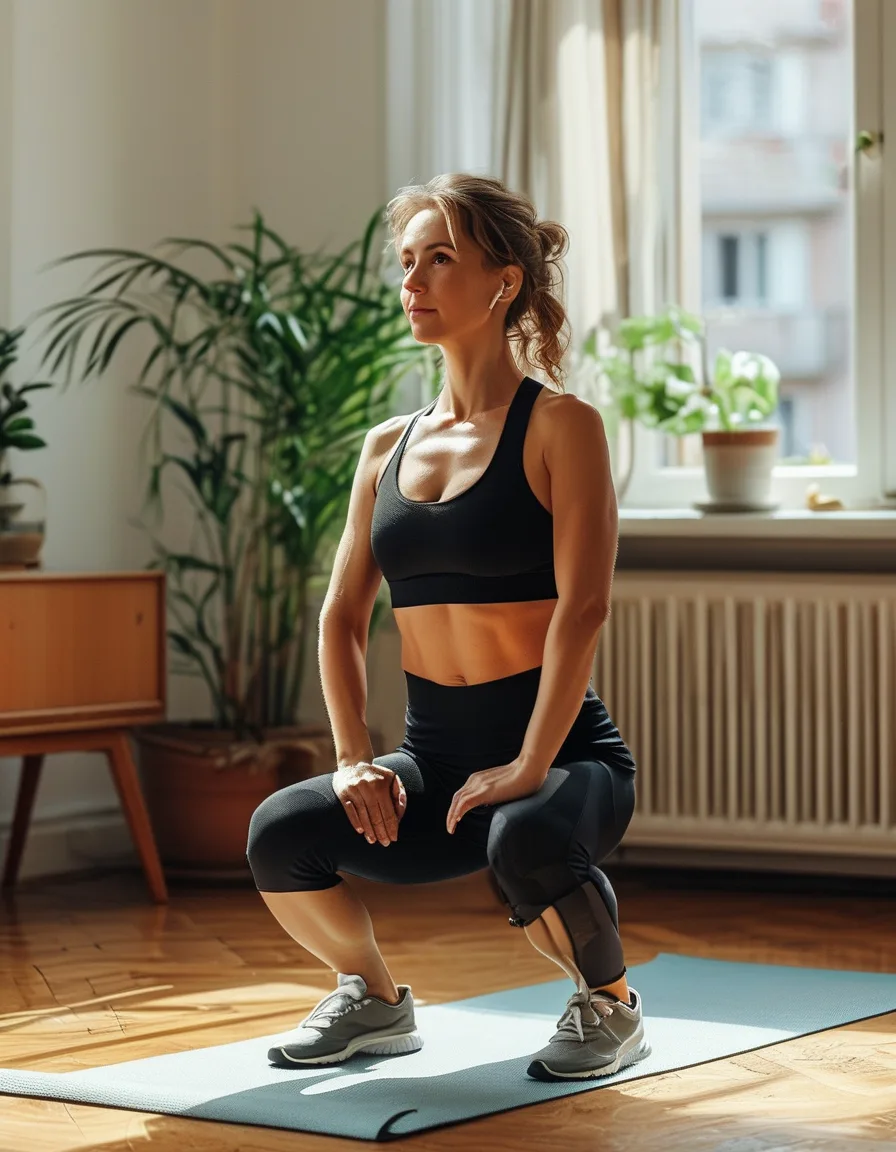
Feet shoulder-width. Lower over 3 seconds, pause 1 second at the bottom, stand over 1 second. The pause is what makes it hard.
2. Reverse Lunges
Step backward, lower slowly, push through the front heel. Backward rather than forward — quieter foot placement and easier on the knees. Alternate legs.
3. Push-Ups (tempo)
Lower over 3 seconds, press up over 1. Hands on a counter or couch if full push-ups aren’t there yet — that progression is better than dropping to your knees.
4. Glute Bridge with Hold
Lift your hips, squeeze hard for 3 seconds at the top, lower over 3. Deceptively brutal by round three.
5. Wall Sit
Back flat against the wall, thighs parallel to the floor, hold for the full 40 seconds. The quietest exercise ever invented and one of the most unpleasant.
6. Bent-Over Rows (backpack)
Load a backpack with books or water bottles. Hinge at the hips, pull the pack to your ribs over 1 second, lower over 3. This is the pull movement the routine would otherwise be missing.
7. Dead Bug
On your back, opposite arm and leg lowering slowly while your lower back stays pressed to the floor. Deep core, no noise, no impact.
8. Plank with Shoulder Taps
Hold a plank, tap alternate shoulders slowly. Keep your hips still — that’s the anti-rotation work.
Cardio option, if you want the heart rate: replace the rest intervals with slow-motion mountain climbers or standing marches with high knees — controlled, soft-footed, no bouncing.
How to Actually Keep It Quiet
The moves matter less than the surface and the footwork.
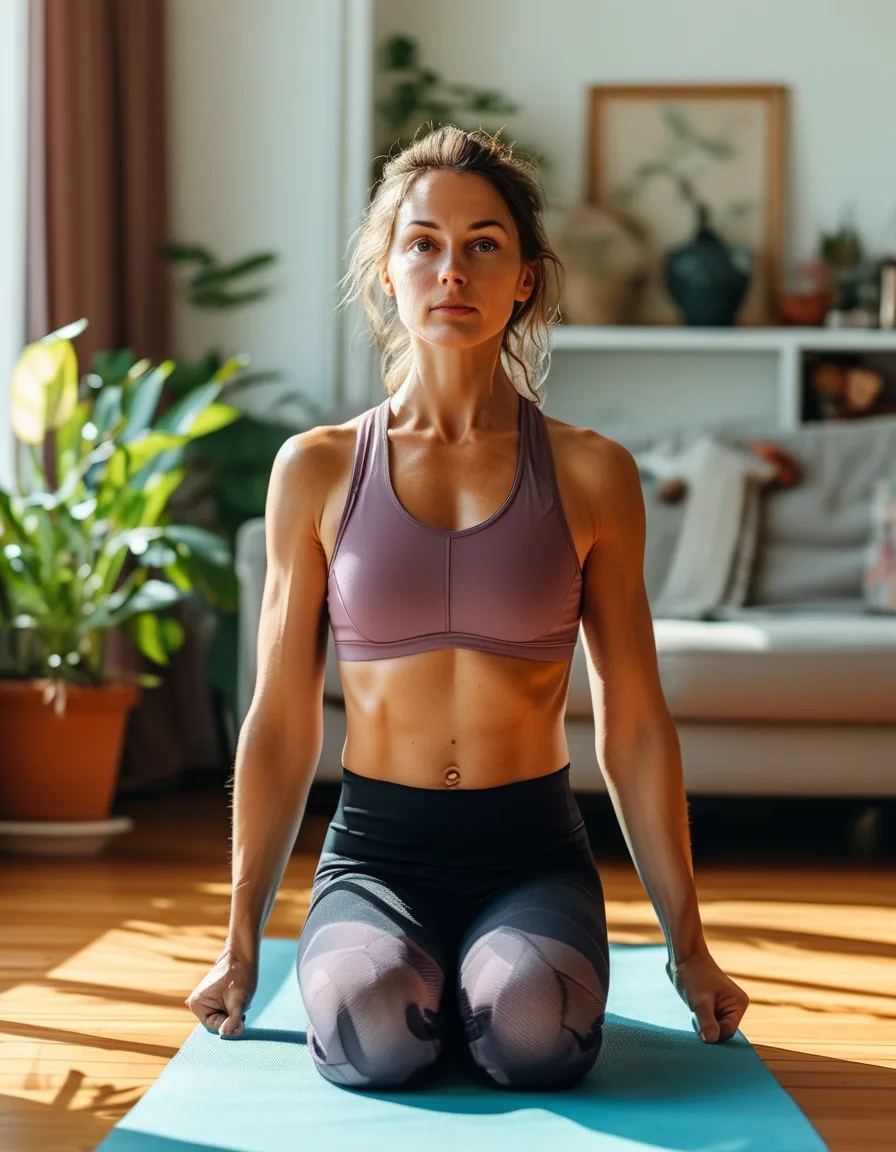
- Get a proper mat. A 6mm or thicker exercise mat, or better, an interlocking foam puzzle mat. This is the single highest-value $25–40 you’ll spend. Thin yoga mats (3mm) do almost nothing for impact noise.
- Land soft, always. Even stepping into a lunge, place the foot rather than dropping it. Think “quiet feet” as an active cue, not a byproduct.
- Barefoot or in socks on the mat. Shoes transmit far more sound through a floor than bare feet do.
- Avoid the corners. Floor joists carry vibration more efficiently near walls. The middle of a room is genuinely quieter.
- Set weights down, don’t drop them. Obvious, and the most common violation.
- Substitute the loud moves. Jumping jacks → step-out jacks. Burpees → walk-out to plank. Mountain climbers → slow, controlled versions. Jump squats → tempo squats with a pause.
The step-out substitution is the general principle: any jumping move has a stepping version that’s often harder when you slow it down.
5 Mistakes That Make Quiet Workouts Ineffective
- Going slow but not actually loading. Slow tempo only works if the muscle is genuinely challenged. If you can do 30 tempo squats comfortably, add a loaded backpack or switch to single-leg.
- Skipping the pull. Bodyweight-only routines are push-heavy — squats, lunges, push-ups, planks. Without a rowing movement you build imbalance. The backpack row is doing important work here.
- Using a thin mat. A 3mm yoga mat is for yoga, not impact dampening. Get thickness.
- Rushing between exercises. The 20-second rest is part of the design. Cutting it doesn’t add intensity, it just degrades your form for the next move.
- Never progressing. Quiet workouts stall exactly like loud ones. Add rounds, slow the tempo further (4 seconds down), extend the work interval to 50 seconds, or move to single-leg variations. This is where most home routines quietly stop working around week eight.
Why Quiet Training Has Advantages
Beyond keeping the peace downstairs:
- You can train at any hour. 6am or 10pm becomes viable, which for a lot of people is the difference between training and not training.
- Slow tempo is safer. Fewer joint impacts, less chance of an awkward landing, and far better form awareness because you can’t hide behind momentum.
- It’s more mindful. Controlled movement forces attention on what the muscle is doing. Most people report feeling target muscles far more clearly at slow tempo.
- It travels. Hotel rooms have the same neighbor problem and this routine needs no equipment beyond a backpack.
When to see a professional: stop if you feel sharp joint pain rather than muscle burn, and check with a doctor before starting if you’re pregnant, recently postpartum, managing a back or knee injury, or have a cardiovascular condition.
Mini FAQ
How can I work out without disturbing downstairs neighbors?
Eliminate jumping entirely, use a 6mm+ exercise mat or foam tiles, train barefoot or in socks, place your feet deliberately rather than dropping them, and work out in the middle of the room rather than near walls where joists carry vibration. Slow tempo and isometric holds provide intensity with zero impact.
Is a no-jumping workout still good cardio?
It can be, if you keep rest short and use continuous movement. Circuit-style training with 40 seconds on and 20 off elevates heart rate substantially. Add controlled options like slow mountain climbers, standing marches, or shadow boxing for more of a cardio effect without leaving the ground.
What’s the quietest exercise equipment for an apartment?
Resistance bands are the quietest — no impact, no clanking, and they pack away. After that: a thick exercise mat, adjustable dumbbells with rubber coating (set them down, never drop them), and a loaded backpack, which is free and works surprisingly well for rows and squats.
TL;DR
- Intensity comes from time under tension, not impact. 3 seconds down, 1 second up, on everything.
- Eight moves, 40 on / 20 off, 3 rounds. About 25 minutes, full body.
- Add isometric holds and single-leg work to raise difficulty without noise.
- A 6mm+ mat is the key purchase. Thin yoga mats don’t dampen anything.
- Include a pull — the backpack row keeps the routine balanced.
- Substitute, don’t skip: step-out jacks, walk-out planks, tempo squats with a pause.
All the effort, none of the noise, and nobody downstairs has to know you train at 10pm.
Keep Reading
This article is for general informational and styling purposes only. Fit, sizing, and product availability may vary.