How to Build a Genuinely Quiet Strength Program: The Complete Guide
Quick Answer: A quiet program works by replacing impact and momentum with time, tension, and range. Slow tempos, isometric holds, unilateral work, and controlled resistance-band tension produce genuine strength adaptation without a single loud moment. The catch is that quiet training progresses differently — you add time under tension and range, not more reps or heavier drops — and that requires a different program structure, which is what this guide lays out.
Most quiet-workout advice is a list of exercises that do not make noise. That is useful for a week and then you stop making progress, because a list is not a program.
Quiet training is a real constraint with a real solution. The solution is not just avoiding jumps; it is a different set of progression variables from start to finish.
This is the full structure: the principles, the movement selection, the progression model, the weekly layout, and the mistakes that stall people.

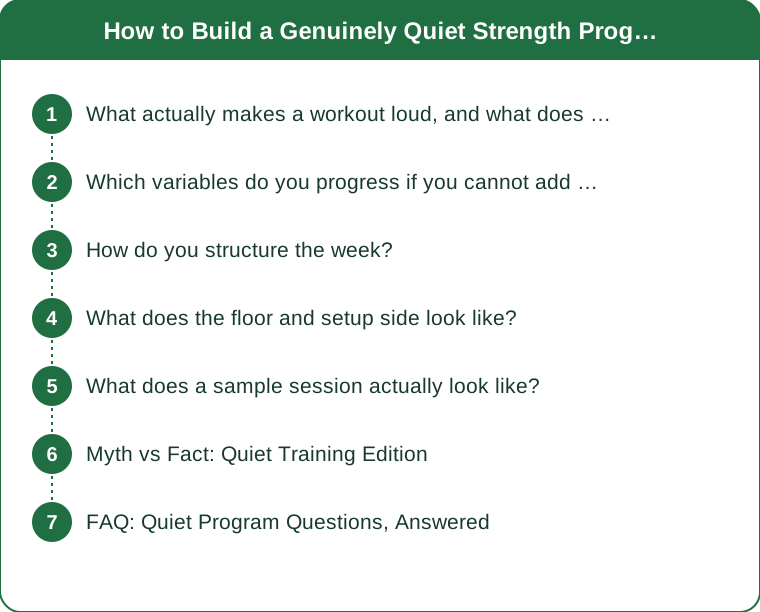
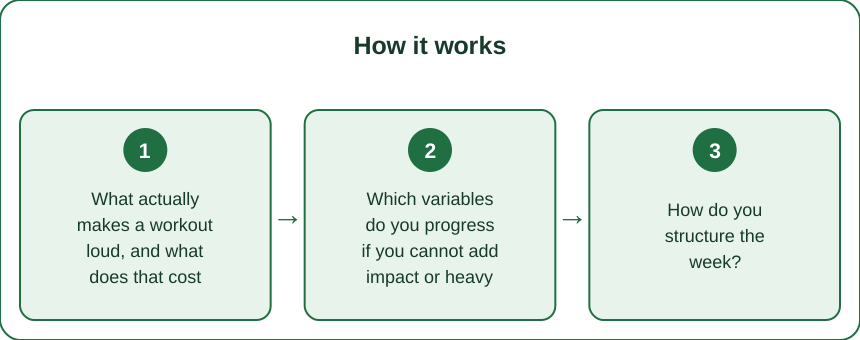
What actually makes a workout loud, and what does that cost you?
Impact, momentum, and dropped load. Understanding which one you are giving up tells you what you need to replace.
Impact is the obvious one. Jumping, running in place, burpees, and box work all create a floor-transmitted thud. Structure-borne sound travels through building frames extremely efficiently, which is why a downstairs neighbor hears a jump you barely felt.
Momentum is the sneaky one. Fast, ballistic movements make noise even without leaving the ground — dumbbells clanking at the top, feet slapping, the mat shifting. Speed is where most residual noise lives once jumping is gone.
Dropped or set-down load is the third. Racking weights, setting a kettlebell down, and even a controlled dumbbell touching the floor all transmit sharply through a floor.
What you lose is rate of force development. Impact and speed-based training develop explosive qualities that slow training does not fully replicate. That is a genuine trade-off and worth stating honestly.
What you keep is nearly everything else. Hypertrophy, maximal strength, muscular endurance, mobility, and work capacity are all fully trainable without a loud moment. For the large majority of people whose goals are strength, body composition, and health, quiet training costs almost nothing — and for anyone with joint concerns, it is often the better choice regardless of neighbors.
Which variables do you progress if you cannot add impact or heavy load?
Five, in a specific order of usefulness. This is the core of the whole method.
One: tempo. Slowing the lowering phase from 2 seconds to 4 seconds increases time under tension by roughly 50% with no change in load. This is the primary progression tool in quiet training and it is remarkably effective for hypertrophy.
Two: isometric holds. Adding a 3 to 5 second pause at the hardest point of a movement raises the demand dramatically and is completely silent. A paused split squat at the bottom is a different exercise from a standard one.
Three: range of motion. Deficit work — front foot on a book, back foot elevated, hands on parallettes — extends the range and increases the challenge without adding weight or speed.
Four: unilateral progression. Moving from two legs to one, or from both arms to one, roughly doubles the load on the working side. This is how bodyweight training gets genuinely hard.
Five: leverage and stability. Changing your body angle or reducing your base of support increases demand. A push-up with feet elevated, or a single-leg hinge, uses geometry instead of weight.
Add resistance bands as the sixth lever. Bands provide progressive tension, are entirely silent, and cover the pulling patterns that bodyweight work handles poorly. A door anchor and three band strengths is the single best purchase for a quiet program.
How do you structure the week?
Three or four sessions, organized around movement patterns rather than muscle groups, with tempo as the built-in intensity dial.
Cover five patterns every week. Squat, hinge, push, pull, and carry or brace. Everything else is optional.
Three full-body sessions is the most robust layout. Each session touches all five patterns with 2 to 3 sets each. It handles missed days gracefully, which matters when your training slot depends on someone else’s nap.
Four sessions allows an upper/lower split. Two lower-focused, two upper-focused, which permits more volume per pattern. Use this if you are training consistently and want more.
Use rep ranges of 6 to 15 with slow tempo. With a 3 to 4 second lowering phase, 8 reps takes 40 to 50 seconds — right in the productive range for hypertrophy. Do not chase high rep counts; chase quality time under tension.
Rest 60 to 90 seconds. Quiet training is not circuit training. Adequate rest is what lets the next set be hard enough to matter.
Progress one variable at a time. Week one, hit your target reps. Week two, add a second to the lowering phase. Week three, add a pause. Week four, increase range or move toward a unilateral version. Then reset the tempo and repeat at the harder variation.

What does the floor and setup side look like?
It matters more than people expect, and the fixes are cheap.
Layer your surface. A thick exercise mat over a rug over the floor decouples much more vibration than a mat alone. Two layers of different density are noticeably better than one thick one.
Never set weights down; place them. Lower a dumbbell to the mat under control with your hand still on it. The sound of weights meeting floor is the most common complaint from neighbors and it is entirely avoidable.
Prefer bands and bodyweight for anything overhead. If a weight might need to be dropped, do not use a weight. Bands remove the failure mode altogether.
Watch furniture as a transmission path. Bracing against a wall or a shared-wall bookshelf transmits sound directly into the neighbor’s room. Use freestanding furniture or the floor instead.
Train barefoot or in soft shoes. Cushioned running shoes make a slapping sound on a mat and reduce your stability. Bare feet are quieter and better for balance work.
Pick your hours anyway. Even a genuinely quiet session at 6am reads as noise to someone asleep. Mid-morning and early evening are the diplomatic windows, and choosing them removes most of the anxiety that makes people train tentatively.
What does a sample session actually look like?
Concrete, silent, and about 35 minutes. Use this as a template rather than a prescription.
Warm-up, 5 minutes. Bodyweight squats to a comfortable depth, hip hinges with a light band, arm circles, ankle rocks. Nothing dynamic enough to make noise.
Squat pattern: tempo split squat. 3 sets of 8 per leg, 4 seconds down, 1 second pause at the bottom, controlled up. Hold a single dumbbell or a loaded backpack if you have one.
Hinge pattern: single-leg hinge. 3 sets of 8 per side, 3 seconds down. Fingertips lightly on a wall for balance is fine and does not reduce the benefit.
Push pattern: tempo push-up or feet-elevated push-up. 3 sets of 6 to 10, 3 seconds down, 2 second pause an inch off the floor. The pause is where the work is.
Pull pattern: band row with door anchor. 3 sets of 12, 2 seconds out, 3 seconds back, squeezing at the end range. This is the pattern most home programs neglect and it matters most for posture.
Brace: side plank and dead bug. 2 sets of 30 to 40 seconds each side, and 2 sets of 8 slow dead bugs. No holding of breath.
Finish: 90 seconds of slow breathing. It genuinely helps recovery and it costs nothing. The whole session should never exceed conversational volume.
Myth vs Fact: Quiet Training Edition
Myth: You cannot build real strength without heavy weights. Fact: training close to failure drives adaptation across a wide range of loads. Slow, hard sets of bodyweight and band work with proximity to failure produce genuine hypertrophy and strength.
Myth: Quiet workouts are just low-intensity workouts. Fact: a paused, tempo, single-leg squat is one of the hardest things most people can do in a living room. Quiet describes the sound, not the effort.
Myth: Isometrics do not build muscle. Fact: long-duration isometric holds produce measurable hypertrophy and strength gains, particularly near the joint angles trained. They are underused rather than ineffective.
Myth: You need to keep adding reps. Fact: rep inflation is the most common quiet-training dead end. Thirty easy reps is worse than eight brutal ones. Progress tempo, range, and leverage instead.
Myth: Cardio is impossible quietly. Fact: sustained tempo circuits, loaded carries around your home, stair work, and long isometric holds all elevate heart rate substantially. Impact is not a requirement for conditioning.
FAQ: Quiet Program Questions, Answered
How long until I see results?
With three consistent sessions a week and genuine proximity to failure, most people notice strength changes in 4 to 6 weeks and visible changes in 8 to 12. The timeline is not different from gym training; the variables you manipulate are.
What is the minimum equipment worth buying?
In order: a thick mat, a set of resistance bands with a door anchor, and one adjustable dumbbell or a backpack you can load. That covers all five movement patterns with room to progress for a year or more.
How do I know if I am close enough to failure?
You should not be able to complete two more reps at the same tempo with the same quality. If you could do five more, the set did not count. This single check fixes most stalled home programs.
Can I train this way long-term or is it a stopgap?
Long-term, for most goals. The one thing you will not develop is explosive power, so if you play a sport that demands it, add that elsewhere. Otherwise a well-progressed quiet program is a permanent solution rather than a compromise.
This is general information, not medical advice. If you have joint or back concerns, get individual guidance before starting a new program.
TL;DR:
- Loud comes from impact, momentum, and set-down load. Removing all three costs you explosive power and almost nothing else.
- Progress five variables in order: tempo, isometric pauses, range of motion, unilateral versions, and leverage or stability.
- Bands with a door anchor cover the pulling patterns bodyweight work misses — the best single purchase.
- Structure the week around five patterns (squat, hinge, push, pull, brace); three full-body sessions is the most robust layout.
- Use 6 to 15 reps with a 3 to 4 second lowering phase, 60 to 90 seconds rest, and change one variable at a time.
- Layer mat over rug, place weights rather than setting them down, avoid shared walls, and train barefoot.
- Rep inflation is the classic dead end. Get close to failure, then progress tempo and range rather than count.
A quiet program is not a watered-down program. It is a program built on different variables, and once you are progressing tempo, pauses, range, and leverage deliberately, the constraint stops being something you work around and becomes the structure that keeps you consistent.
Keep Reading
This article is for general informational and styling purposes only. Fit, sizing, and product availability may vary.