The Real Source of Workout Noise Isn't What You Think — A Full Breakdown
Quick Answer: Most apartment workout noise complaints trace back to impact transfer through the building’s structure — footfalls and landings vibrating through the floor joists to the unit below — not airborne sound like breathing or grunting, which barely carries through a single floor at all. Once you understand that distinction, quiet training becomes a matter of controlling landings, not staying silent.
A lot of people whisper-count reps and avoid any noise at all, while the actual complaint-generating movement — a hard jump landing — happens right in the middle of their ‘quiet’ routine.

Why does impact noise travel through floors so much more effectively than voice or breath does?
Airborne sound (talking, breathing, most exercise equipment hum) has to travel through air, hit a surface, and re-radiate on the other side, losing a substantial amount of energy at each step — by the time it reaches a floor below, it’s usually reduced to background-level noise. Impact noise works completely differently: a landing foot transfers force directly into the floor structure itself, and that structure — joists, subfloor, sometimes even wall studs — carries the vibration efficiently to adjacent rooms and floors with much less energy loss along the way. This is why a downstairs neighbor can clearly hear a jump landing through a floor that fully blocks a phone conversation happening in the same spot, and it’s the single most useful fact for anyone trying to train quietly: the enemy is landing force, not sound volume in the everyday sense.
What specific movements generate the most structural impact, and which ones are safe to keep as-is?
Jumping movements — box jumps, jump squats, plyometric lunges, burpees with a jump component, and any double-unders or high-impact cardio — are the primary offenders, because they combine bodyweight, gravity, and a hard landing into a single transmitted force spike. By contrast, controlled strength movements like squats, deadlifts (without dropping the weight), push-ups, planks, and most isometric or slow-tempo work generate very little structural noise regardless of how hard you’re breathing or how loud your form cues are. A useful mental filter while building a quiet routine is asking whether your feet (or a weight) are about to leave contact with the floor and land again — if yes, that’s the moment to modify; if no, the exercise is probably already fine as written.
How do you modify a jump-based exercise so it still trains the same qualities without the impact spike?
The general principle is replacing the landing, not the movement pattern — a jump squat becomes a fast eccentric squat with a controlled, silent step down instead of a jump; a burpee’s jump becomes a step-back-step-in transition; box jumps become step-ups performed explosively on the way up. These modifications preserve most of the speed, power output, and cardiovascular demand of the original movement while removing the specific moment (ground contact after airborne time) that generates structural noise. It takes some practice to make these substitutions feel natural, since the instinct during fast-paced training is to jump, but deliberately controlling the landing — almost ‘catching’ your own bodyweight rather than dropping into it — becomes automatic within a few sessions.
What role does flooring actually play, and is it worth investing in?
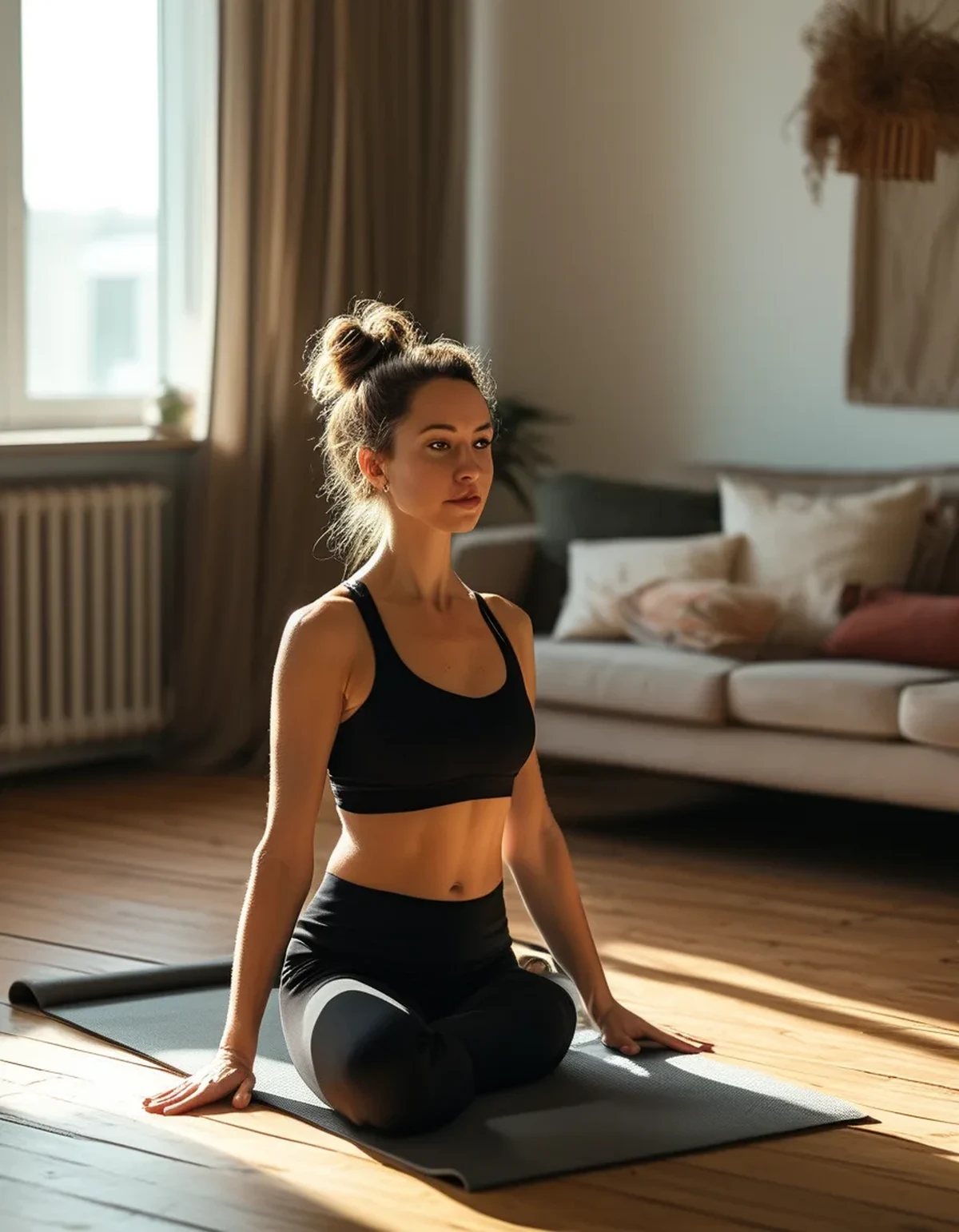
Flooring helps meaningfully but has real limits — a dense interlocking foam mat or a proper impact-rated gym tile absorbs some of the shock at the point of contact, reducing (not eliminating) how much force transfers into the subfloor, which is genuinely useful for movements that still involve some impact (single steps, light hopping). What flooring can’t do is fully neutralize a hard jump landing on a typical residential floor structure — the mat helps at the margins, but it isn’t a substitute for modifying the highest-impact movements themselves. For anyone serious about consistent quiet training, a combination of a quality mat plus modified movement selection covers the situation much more completely than either alone.
What Nobody Tells You About Training Quietly Long-Term
The habit that actually breaks down over time isn’t movement selection — it’s time-of-day discipline. Most people modify their exercises carefully for the first week and then, once a routine feels established, start sneaking in ‘just one set’ of jump-based work during an early morning or late evening session because it’s faster or feels more satisfying. That single set is disproportionately likely to generate a complaint precisely because it happens outside the hours when ambient building noise (traffic, other units’ activity) would otherwise mask it. The other under-discussed reality is that mental toughness genuinely differs in silent training — without music at a normal volume or the psychological lift of loud, explosive movement, workouts can feel harder to push through even at the same objective intensity, which is worth planning for rather than being surprised by.
How should a full quiet workout actually be structured from warm-up to finisher?
A warm-up built around dynamic stretching and slow controlled movement (leg swings, walking lunges, band work) generates essentially no noise and gets several minutes of low-impact preparation in before anything demanding starts. The main strength block should lean on the low-impact movements covered earlier — squats, presses, rows, planks, controlled tempo work — which can be loaded heavily enough to be genuinely challenging without any impact component at all. For a cardio or conditioning finisher, modified versions of jump-based intervals (step-back burpees, fast mountain climbers, shadow boxing, high-effort walking intervals) can hit a comparable heart rate to their jumping counterparts when performed with real intensity and shortened rest, even though they’ll never generate quite the same explosive power output as their loud originals.
FAQ: Quiet Workout Questions, Answered
Can you still build real strength and power training only quiet variations?
Yes for strength almost entirely, and largely for conditioning — the main tradeoff is explosive power development, since true plyometric jump training has a genuine training effect that controlled variations only partially replicate, which matters mainly for athletes training for jump-specific sports rather than general fitness.
What time windows are actually safest for a quiet routine, if any impact is unavoidable?
Mid-morning to early evening on weekdays tends to have the most ambient background noise from a building’s normal daily activity, which naturally masks incidental noise better than early morning or late night, when a building is at its quietest and even modest sounds carry further.
Is it worth talking to a downstairs neighbor directly instead of just modifying everything?
Often yes — a brief conversation about workout timing and a genuine effort to modify high-impact movements together tends to resolve tension far better than either silently worrying about noise or assuming nothing can be done, and most people respond well to visible effort even if a routine isn’t perfectly silent.
TL;DR:
- Structural impact noise (landings), not breathing or talking, is the real source of most complaints
- Jump-based movements are the main offenders; controlled strength work is usually already fine
- Replacing the landing moment (not the whole movement) preserves most of the training effect
- A dense mat helps at the margins but doesn’t fully solve high-impact movements alone
- Time of day and a direct conversation with neighbors both meaningfully reduce real-world friction
The goal isn’t a silent workout — it’s controlling the specific moments that actually transfer through the building.
Keep Reading
This article is for general informational and styling purposes only. Fit, sizing, and product availability may vary.