The Complete Guide to Quiet Home Workouts Once the Windows Close
Quick Answer: Closed windows raise indoor reverberation and remove the outdoor masking noise that hid your session all summer, so the same workout is measurably more audible even though nothing about it changed. The fixes are decoupling from the floor, shifting to slower tempo work, and moving your session into the building’s own noisy hours.
You have been doing the same quiet routine since June without a word from anyone.
The first cold week arrives, everyone shuts their windows, and suddenly you are aware of every single rep.
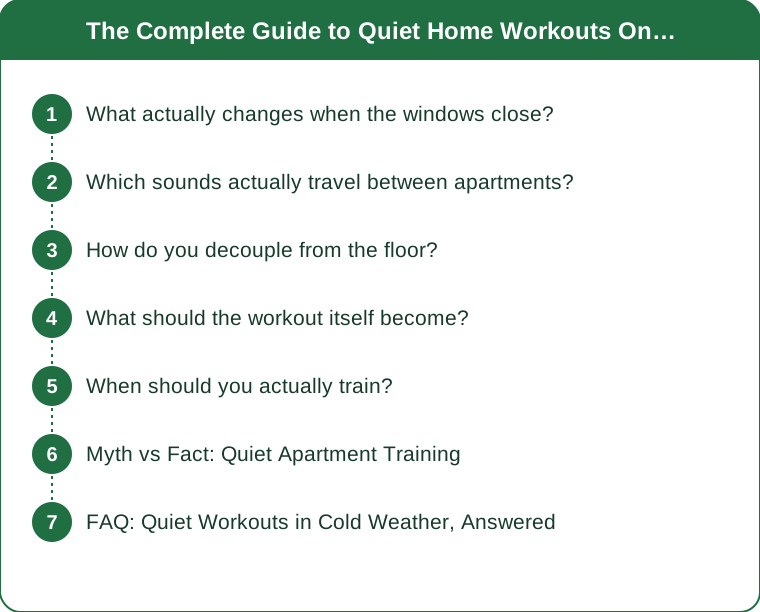
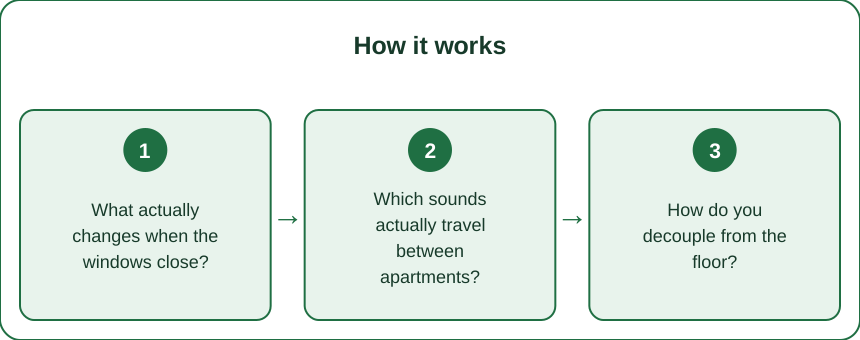
What actually changes when the windows close?
Three separate acoustic changes happen at once, and all of them work against you.
You lose the masking noise. Open windows all summer meant traffic, air conditioning units, birds, and people outside — a constant background that hid moderate indoor sound. That background can be 10 to 15 decibels of cover, and it disappears entirely in one week. Nothing about your workout got louder; the floor beneath which it was hidden rose out from under it.
Reverberation increases indoors. An open window is an absorbent hole in the room. Closed, the room becomes a harder, more reflective box, and sound bounces longer before it decays. The same impact sounds sharper and lasts longer in your own space, which is also what the neighbors hear.
Everyone is home more. The acoustic environment did not change alone — the audience did. A 7am session heard by nobody in July is heard by a neighbor working from home in October.
Heating systems add their own transmission paths. Radiators, ducts, and pipes connect apartments structurally. In buildings with forced air, ducts carry sound between units efficiently, and that path opens up the week the heating comes on.
Humidity drops, which changes floor behavior. Wood floors contract slightly in dry heated air, opening small gaps and increasing squeak. A floor that was silent in humid August can develop a creak in a heated apartment for reasons entirely unrelated to you.
Which sounds actually travel between apartments?
Understanding the two categories is what makes the rest of this efficient.
Impact noise is the real problem. Anything striking the floor transmits directly into the building structure and radiates from the ceiling below. Jumping, dropping a weight, and even heel-striking during a lunge are impact sounds, and they travel through concrete and wood far better than through air.
Airborne noise is easier to contain. Music, breathing, a video instructor talking. It travels through air gaps, doors, and thin walls, and it is substantially reduced by simply closing doors and lowering volume.
Low frequencies travel furthest. A jump produces a low-frequency thud that passes through structure with very little attenuation. High-frequency sounds — a clap, a resistance band snap — die out much faster. This is why bass from a neighbor’s music reaches you and the melody does not.
The vibration path is not always downward. In apartment buildings with concrete floors, impact energy travels laterally as well. Complaints occasionally come from beside or diagonally below, which surprises people who have only considered the unit underneath.
Continuous sound is more irritating than loud sound. Ten minutes of rhythmic jumping registers far more with a neighbor than one heavy dropped object, even at a lower peak volume. The rhythm is what makes it impossible to ignore.
Your own perception is the least reliable instrument you own. You cannot hear what leaves your apartment. The only honest test is asking a neighbor, or standing in the hallway while someone else does the routine.
How do you decouple from the floor?
This is the highest-return intervention available and most people do a partial version of it.
Mass alone does not stop impact noise. A single thin yoga mat spreads the contact area and does almost nothing for transmission into the structure. It feels like a solution and measures like almost nothing.
Layering different materials is what works. A dense rubber mat over a foam layer over carpet creates multiple impedance changes, and each transition reflects some energy back. Three thin layers of different materials outperform one thick layer of the same total depth.
Aim for a compressible layer under a rigid one. Foam directly under a firm rubber mat lets the rigid layer distribute the load while the foam absorbs the energy. Reverse the order and the foam simply compresses through.
Horse stall mats are the standard heavy solution. Three-quarter inch dense rubber, sold by weight, and genuinely effective under a weight area. Heavy, unattractive, and the most cost-effective real fix available.
Interlocking foam tiles are the practical compromise. Two layers offset so the seams do not align, with a rug underneath. This handles bodyweight training in most buildings.
Cover the whole training area, not a mat-sized patch. Stepping off the edge mid-set is the exact moment the loudest impact happens, and it is the most common way a good setup fails.
What should the workout itself become?
Change the movement pattern, not just the surface under it.
Replace ballistic movement with tempo work. A jump squat becomes a 4-second-down, 1-second-up squat. The training stimulus is comparable and the acoustic footprint is essentially zero. This substitution alone solves most quiet training problems.
Use isometrics for intensity without motion. Wall sits, planks, split squat holds, and overcoming isometrics against a fixed object produce high demand with no impact at all. They are underused because they are unpleasant, not because they are ineffective.
Bands replace anything that would be dropped. Resistance bands provide progressive load with no mass to hit the floor. Their limitation is the strength curve, not the noise, and for most home training that is an acceptable trade.
Slow eccentrics substitute for added load. If you cannot add weight quietly, add time. A 5-second lowering phase on a push-up or a split squat increases the demand meaningfully without a single new object in the apartment.
Unilateral work raises intensity without impact. Single-leg squats, single-arm rows, and single-leg hip thrusts double the relative load using only your bodyweight. This is the main progression route in a quiet program, and it is the one that keeps working after six weeks.
Keep the landing quiet as a skill, not just a constraint. Learning to land softly — knees bending on contact, forefoot first, weight absorbed rather than stopped — is a legitimate movement skill worth training. It transfers directly to running and jumping outside the apartment.
Accept what you cannot do. Some things are genuinely incompatible with a quiet apartment: heavy Olympic lifting, plyometric depth work, and skipping on a suspended wood floor. Recognizing that saves you from a bad compromise that satisfies nobody.
When should you actually train?
Timing is free and does more than most equipment.
Between 8am and 8pm is the general legal safe zone in most jurisdictions, but building custom is what determines complaints, not the ordinance. Quiet hours in leases are commonly 10pm to 8am.
Train during the building’s own noisy hours. Right after most people leave for work, or in the early evening while dinners are being made and televisions are on. Ambient building activity is masking noise, and it is completely free.
Avoid the two quiet peaks: early morning and late evening. The building is at its most acoustically transparent at 6am and 11pm, which is exactly when the schedule tempts you to train.
Shift your session as the season shifts. A 6:30am summer workout, hidden by open windows and traffic, becomes conspicuous in October. Moving it to 7:30 costs you very little and changes everything about who hears it.
Keep sessions under 45 minutes on weekdays. Duration drives irritation more than volume does. A short session at a slightly higher noise level generates far fewer complaints than a long one at a lower level.
Talk to the neighbor below before there is a problem. A two-minute conversation about when you train and an invitation to tell you if it is disruptive prevents the vast majority of escalations. It works because it converts an anonymous noise into a known person.
Myth vs Fact: Quiet Apartment Training
Myth: A thick yoga mat solves impact noise. Fact: A single foam layer barely dents structural transmission. It improves your comfort and the sound in your own room while doing little for the apartment below. Layered materials of different densities are what actually work.
Myth: Bodyweight training is inherently quiet. Fact: Burpees, mountain climbers, and jumping jacks are among the loudest things you can do in an apartment, and none of them involve equipment. Movement pattern determines noise, not whether you own weights.
Myth: Training on carpet is enough. Fact: Carpet absorbs high-frequency airborne sound well and does little for low-frequency impact. It is a useful layer in a stack and not a solution by itself.
Myth: If the neighbors have not complained, it is fine. Fact: Most people tolerate noise for months before saying anything, and by the time they do it has become a grievance rather than a request. Asking proactively gets you honest information while it is still easy to act on.
Myth: Quiet training cannot progress. Fact: It progresses differently. Load progression is limited; tempo, unilateral variation, range of motion, and density progression are not. Programs stall around week six precisely because people keep trying to progress load in a setting that cannot support it.
Myth: Noise-cancelling headphones help. Fact: They help you and change nothing for anyone else — and they make it harder to hear how loud you are being, which usually makes the situation worse rather than better.
FAQ: Quiet Workouts in Cold Weather, Answered
Why is my workout louder now than it was in summer?
Two reasons: closed windows removed the outdoor masking noise that was covering it, and the room itself became more reverberant without an open absorbent gap. Your session is the same; the acoustic background it sat against has dropped away.
What is the single most effective thing to buy?
Dense rubber matting — three-quarter inch stall mats or equivalent — laid over a foam layer, covering the whole training area rather than a mat-sized patch. It costs more than a yoga mat and is the only purchase that reliably changes what the apartment below hears.
Can I still do HIIT in an apartment in winter?
Yes, with substitutions. Replace jumping with tempo squats, mountain climbers with slow bear crawls or plank variations, and burpees with a step-back version. The heart rate response is preserved; the impact is not. Intensity was never the noisy part — the landings were.
Should I tell my neighbors I work out at home?
Yes, and before there is any issue. A brief conversation naming your usual time and asking them to tell you if it is disruptive resolves most problems before they form. It also means that if something does bother them, you hear about it as feedback rather than as a complaint to the building.
TL;DR:
- Closed windows remove 10 to 15 dB of outdoor masking noise and make the room more reverberant — your session did not get louder, its cover disappeared.
- Impact noise is the real problem; layer different materials rather than adding one thick mat, and cover the whole training area.
- Substitute tempo work, isometrics, and unilateral variations for anything ballistic — the stimulus survives, the noise does not.
- Train during the building’s own busy hours and keep weekday sessions under 45 minutes.
- Talk to the neighbor below before there is a problem; it is the cheapest intervention available.
Nothing about your training changed this month. The building simply stopped covering for you, and rebuilding the session around that takes an afternoon.
Keep Reading
This article is for general informational and styling purposes only. Fit, sizing, and product availability may vary.