The Real Reason Your 'Quiet' Workout Still Shakes the Floor (It's Not the Jumping)
Quick Answer: Floor noise from workouts mostly comes from landing speed, not landing height — a slow, controlled step-down can be louder through a floor than a small hop, because deceleration technique matters more than whether your feet leave the ground.
You did the whole ‘quiet’ version: no jumping jacks, no burpees, step-touches instead of jump squats. Your neighbor still texted. Before you assume you need an entirely different workout, it’s worth understanding what floors actually transmit — because it’s probably not what you think.
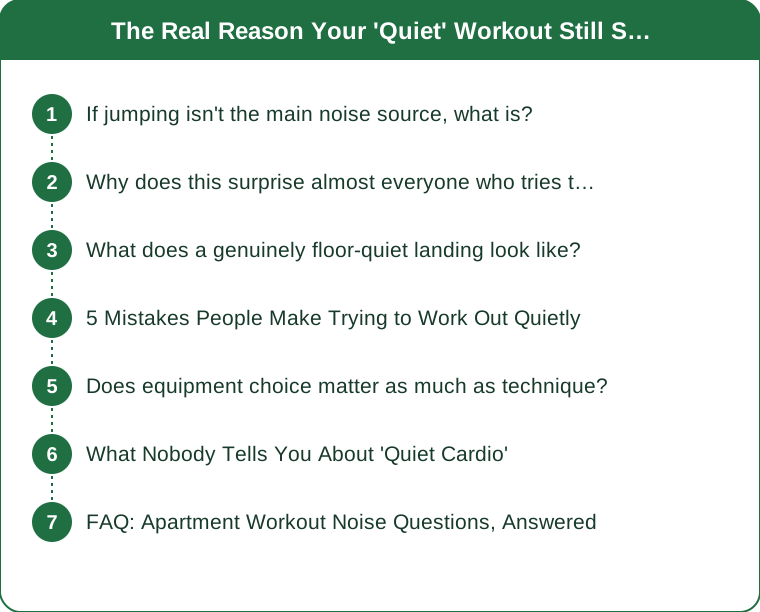
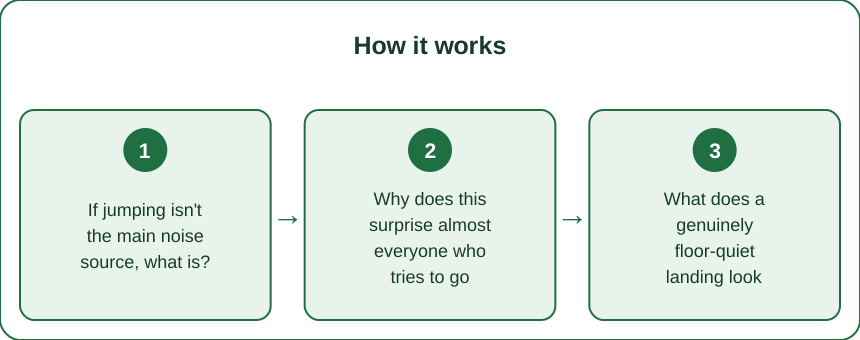
If jumping isn’t the main noise source, what is?
Deceleration speed. A floor transmits force based on how quickly momentum stops, not how far something traveled. A person who steps down from a low step slowly, controlling the landing over half a second, sends far less impact through the floor than someone who plants a foot hard and fast even from standing height with zero air time.
This is why a ‘no-jump’ modification can still be loud — if you’re still snapping your foot down fast to keep pace with music, you’ve kept the exact variable that transmits sound while removing the one (height) that barely mattered.
Why does this surprise almost everyone who tries to go quiet?
Because visually, jumping looks like the loud part — it’s the dramatic movement. But acoustically, a controlled lunge done fast with a hard heel strike can register more impact noise than a jump landed with bent knees and a rolling foot strike.
Most apartment workout guides tell you to remove jumps and call it done. That’s an incomplete fix. The actual instruction should be: slow every landing down, regardless of whether your feet ever left the ground.
What does a genuinely floor-quiet landing look like?
Three things, in order of importance:
- Land toe-to-heel, never heel-first. Heel-first landings transmit almost all their force directly into the floor joists in one sharp spike.
- Bend the knee through the landing. A stiff-legged stop is a hammer; a knee that flexes through impact is a shock absorber.
- Count a full second of deceleration, even from a standing step. If you can say ‘one-one-thousand’ during the landing, you’re controlling it; if it’s instant, you’re not.
This applies whether you’re doing a jump squat, a fast lunge, or just walking briskly across a hardwood floor at 6am.
5 Mistakes People Make Trying to Work Out Quietly
1. Removing jumps but keeping the tempo. Fast music tempo pulls your landings fast too, jump or no jump.
2. Ignoring furniture placement. A rug pad under just your workout mat does little if your dumbbells still clank onto bare floor beside it.
3. Assuming carpet solves everything. Carpet dampens surface noise (footsteps you’d hear in the room) far more than structure-borne noise (vibration through joists your downstairs neighbor feels), which is the one that actually travels.
4. Skipping a proper floor mat for strength work. A 6mm yoga mat does nothing for a dropped dumbbell; you need a dedicated rubber floor mat rated for impact.
5. Working out at the same fast tempo you’d use with real gym flooring underneath. Commercial gym floors are engineered to absorb force your apartment subfloor isn’t.
Does equipment choice matter as much as technique?
Some, but less than people assume. A rubber interlocking floor mat (not a yoga mat) under your workout zone meaningfully cuts vibration transfer — figure a noticeable, reportable difference to anyone below you. But even the best mat can’t fully compensate for a hard, fast landing technique.
Think of equipment as a 20% fix and landing control as the 80% fix. People who buy an expensive mat and keep snapping their landings down are often disappointed the complaints continue — because they fixed the smaller variable.
What Nobody Tells You About ‘Quiet Cardio’
Here’s the uncomfortable truth: a genuinely quiet high-intensity workout is a slower workout, at least in tempo. Controlling every landing over a full second instead of snapping it down instantly means your rep count per minute drops. That’s the actual tradeoff nobody mentions when they hand you a ‘no-jump’ modification list.
The good news: slower, controlled landings also mean better joint control and often more muscle tension per rep, since you can’t rely on momentum to carry you through. Many people find their quiet version is, if anything, a harder strength stimulus — just at a different pace and for different reasons than the loud version.
FAQ: Apartment Workout Noise Questions, Answered
Does time of day matter more than technique?
Somewhat — early morning and late evening carry sound better in most buildings because ambient noise is lower, so the same workout that’s fine at 6pm can be more noticeable at 6am, even with identical technique.
Will a thicker mat alone solve complaints?
Usually not completely. A thick rubber mat helps but a fast, heel-first landing on top of it still transmits meaningful force — pair the mat with slower landing control for the best result.
Is running in place ever actually quiet?
Only with a deliberate forefoot strike and low knee lift. A high-knee run in place, even without traveling anywhere, produces the same repetitive impact spikes as jogging and is one of the most commonly under-modified ‘quiet’ exercises.
TL;DR:
- Landing speed, not jump height, is the main source of floor noise
- A slow, knee-bent, toe-to-heel landing beats removing jumps but keeping fast tempo
- Rubber mats help (~20%) but technique is the bigger fix (~80%)
- Quiet workouts are genuinely slower-tempo workouts — that’s the real tradeoff
Next session, keep one exercise exactly as-is and just slow the landing to a full second — that single change usually does more than an entire ‘no-jump’ modification list.
Keep Reading
This article is for general informational and styling purposes only. Fit, sizing, and product availability may vary.