Why Quiet Workouts Need a Completely Different Progression Model
Quick Answer: Conventional programs progress by adding impact, speed, or external load — all three of which are exactly what quiet training removes. Silent workouts progress instead through time under tension, range of motion, leverage, unilateral loading, and rest manipulation. These levers are legitimate and well-supported; they just require a different plan than the one most programs hand you.
The advice for progressing a workout assumes you can jump, drop a dumbbell, and move fast. Take those away and most programs simply stop having anything to say. That’s a gap in the programs, not a ceiling on what’s possible in an apartment.

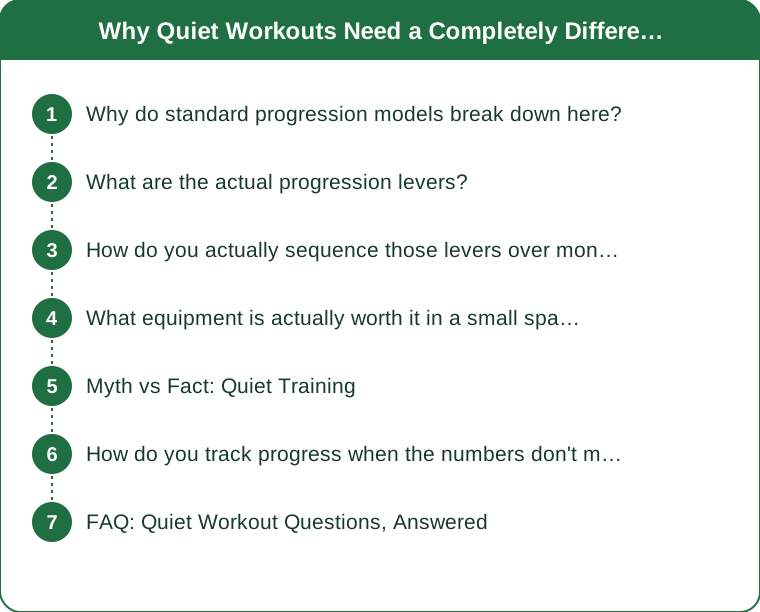
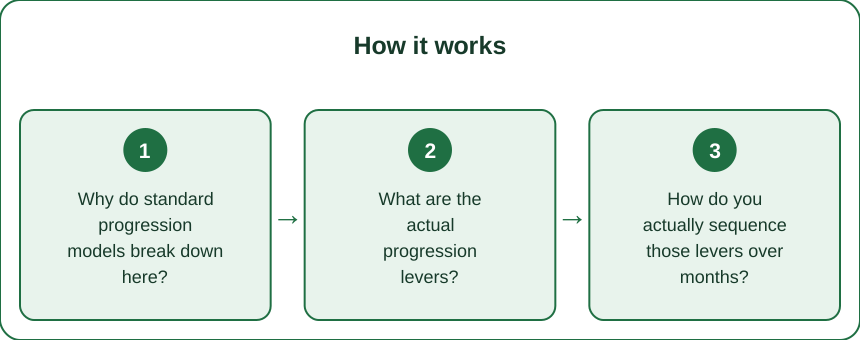
Why do standard progression models break down here?
Nearly every mainstream progression scheme rests on one of three levers: add external load, add speed or impact, or add volume. In a shared-wall apartment, the first is limited by storage and by the noise of setting weights down, the second is limited by floor transmission, and the third runs into time.
That leaves a lot of people concluding that quiet training has a low ceiling. It doesn’t — it has a different set of levers, and most of them are less familiar because commercial gyms have no reason to emphasize them.
What noise actually travels
Worth being precise, because it changes what you need to avoid. Impact noise — footfalls, dropped weight, jumping — transmits through the building structure itself and is what neighbors below actually hear. Airborne noise, like breathing hard or music, transmits far less through floors.
This means the constraint is narrower than most people assume. You don’t need to be silent; you need to avoid transmitting force into the floor structure. Slow, controlled, continuous-tension work does this almost automatically, which is convenient, because that’s also excellent training.
What are the actual progression levers?
Five, roughly in order of how much runway they offer.
Time under tension. Slowing the eccentric phase from one second to four increases total mechanical stress substantially without changing anything else. A push-up with a 4-second lowering is a meaningfully harder exercise than the same push-up done at normal tempo, and it’s completely silent.
Range of motion. Deficit work — hands or feet elevated so the movement travels further — increases both the muscular demand and the stretch at the bottom position. A deficit split squat off a book stack is a different exercise from the flat-ground version.
Leverage. Changing body position changes the moment arm. Shifting from a knee push-up to a full push-up to a feet-elevated push-up is a leverage progression, and each step is significant.
Unilateral loading. Moving from two limbs to one roughly doubles the load on the working side while adding a stability demand. This is the single biggest available jump in bodyweight training and most people underuse it.
Rest manipulation. Shortening rest increases metabolic demand at the same mechanical load. Useful, but it’s the lever with the least long-term runway, so it belongs last.
How do you actually sequence those levers over months?
In roughly the order above, because they differ in how much room each has before it runs out.
Months one and two: tempo. Take your existing exercises and slow every eccentric to 3-4 seconds. Keep everything else identical. Most people find this alone reduces their achievable rep count by a third, which tells you how much stimulus it added.
Months three and four: range. Introduce deficits — elevated hands for split squats, a low step for deficit push-ups, a rolled towel to increase depth. Range progressions also carry a mobility benefit that the other levers don’t.
Months five and six: leverage and unilateral. This is where the largest strength jumps live. Single-leg work, feet-elevated pressing, and asymmetric loading patterns.
Ongoing: rest. Once the other levers are in play, use rest as a fine adjustment rather than a primary driver.
Why the order matters
Starting with unilateral work — which is where people naturally jump when they get bored — burns the biggest lever first and leaves you with nowhere to go. Sequencing preserves runway, and runway is what turns an apartment routine into a multi-year one rather than a three-month one.

What equipment is actually worth it in a small space?
Very little, and the useful pieces are specifically the quiet ones.
Resistance bands are the highest-value purchase by a wide margin. They provide variable resistance, make almost no noise, store in a drawer, and cover both upper and lower body. A set with several tension levels effectively adds an entire load-progression lever back into a quiet program.
A single moderate kettlebell or dumbbell pair adds load, but only if you commit to placing it down rather than dropping it. The noise risk is entirely in the set-down.
A thick mat does more than comfort — it reduces impact transmission meaningfully for the ground-based work that makes up much of a quiet routine.
Furniture sliders are almost free and unlock a whole category of continuous-tension movements: sliding lunges, hamstring curls, mountain climbers without impact.
What isn’t worth it
Jump ropes, plyo boxes, and most cardio machines belong to the category the constraint was designed around. A treadmill in an apartment transmits considerably more than most people expect, and it’s the most common regretted purchase in this category.
Myth vs Fact: Quiet Training
Myth: You can’t build real strength without heavy external load. Fact: Load is one route to mechanical tension, not the only one. Research on training to proximity of failure suggests that lighter loads taken close to failure produce comparable hypertrophy to heavier loads, which is exactly the situation quiet bodyweight training creates.
Myth: Without jumping you can’t train power. Fact: True in part — genuinely explosive training does require impact or heavy load. But power is one quality among many, and most non-athletes have larger gaps elsewhere.
Myth: Quiet workouts are inherently low-intensity. Fact: Slow tempo work at proximity to failure is intensely demanding. Perceived difficulty and noise are unrelated variables.
Myth: A yoga mat solves the noise problem. Fact: A mat helps considerably with impact transmission but doesn’t eliminate it. Avoiding the impact in the first place works far better than damping it after the fact.
Myth: You need a full hour for it to count. Fact: Tempo-based work is time-efficient specifically because each rep takes longer. A well-constructed 25-minute session with 4-second eccentrics contains more time under tension than a 45-minute conventional one.
How do you track progress when the numbers don’t move?
This is the real difficulty with quiet training, and it’s a measurement problem rather than a training one. Without external load, the obvious progress number disappears, which makes it easy to feel stuck while genuinely improving.
Track tempo and reps together as a single figure. Eight reps at a 4-second eccentric is a different and larger number than eight reps at a 1-second eccentric, but a plain rep log records both as eight. Writing 8 × 4s captures what actually changed.
Track the hardest variation you can complete with good form. Progressing from knee push-ups to full push-ups to feet-elevated push-ups is unambiguous progress that no rep count reflects.
Track reps in reserve. Ending a set with two reps left in the tank, and noticing over weeks that the same set now ends with four, is meaningful data.
The honest limitation
There is a ceiling. Very advanced strength development does eventually require external load, and no amount of clever bodyweight programming fully substitutes for it. But that ceiling sits far higher than most people training in apartments will reach in several years — which makes it a theoretical constraint rather than a practical one for nearly everybody reading this.
FAQ: Quiet Workout Questions, Answered
How slow is too slow for tempo work?
Beyond about 5-6 seconds per phase, form usually degrades and the set becomes an endurance exercise rather than a strength one. Three to four seconds is the productive range for most people.
Can I do cardio quietly at all?
Yes — sliding mountain climbers, low-impact step patterns, shadow boxing, and continuous-tension circuits all raise heart rate substantially without impact. The heart rate doesn’t know whether you jumped.
Will neighbors hear resistance band work?
Almost never. Bands produce no impact transmission, which is the component that travels through floors. The main noise risk is an anchor point knocking against a door.
Is training barefoot better for noise?
Yes, noticeably — shoes transmit more impact through a floor than bare feet or socks do, particularly hard-soled trainers.
How do I know if I’m actually being quiet?
Ask once. A neighbor’s answer is more reliable than any amount of guessing, and it usually turns out either fine or fixable with one specific change.
TL;DR:
- Standard progression relies on load, speed, and impact — all restricted in quiet training
- The available levers are tempo, range, leverage, unilateral loading, and rest
- Sequence them in that order to preserve runway over months rather than weeks
- Bands, sliders, and a thick mat are the only equipment worth the space
- Track tempo × reps and hardest variation, not rep count alone
- The real ceiling exists but sits far above where most apartment trainees will get
Quiet training isn’t a compromised version of real training. It’s a version that uses less familiar levers — and the ones it uses happen to be the levers most conventional programs neglect.
Keep Reading
This article is for general informational and styling purposes only. Fit, sizing, and product availability may vary.