Why Quiet Workouts Plateau and How to Restart Progress
Quick Answer: Quiet workouts plateau at around six to eight weeks because the usual progression tools — jumping, heavier loads and faster tempo — are all noisy. Once bodyweight movements become easy, there is no obvious next step. The way through is to progress on the axes that stay silent: tempo (slower), leverage (harder positions), range of motion, unilateral work, and rest periods. All five increase difficulty substantially without adding a single decibel.
Weeks one to five were genuinely great.
Week seven, the same session that used to be hard is now just something you get through.
The programme has not failed. It has simply run out of the one variable it was using.

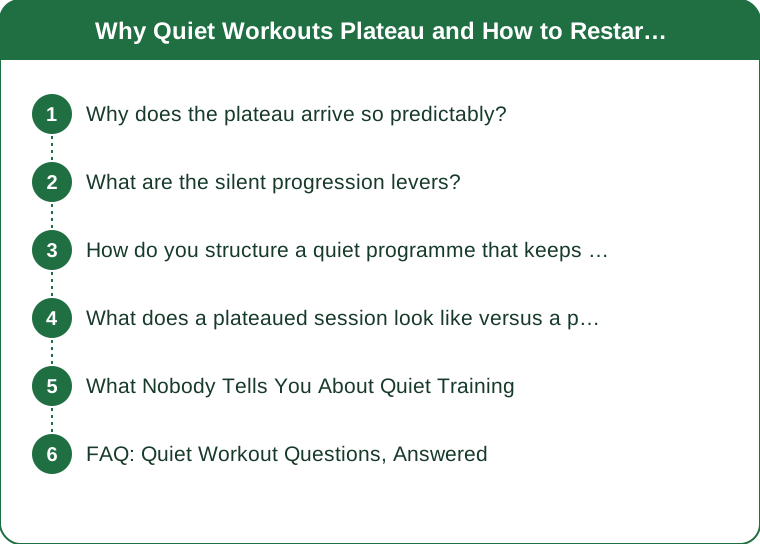
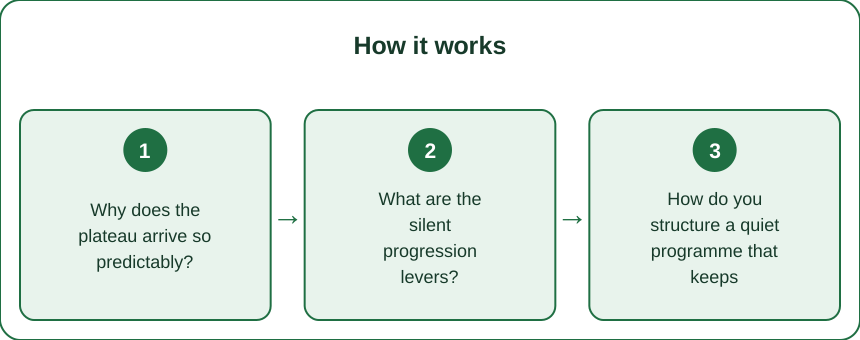
Why does the plateau arrive so predictably?
Because quiet training tends to progress on volume alone, and volume is the weakest of the progression levers.
The obvious progressions are all noisy. Jumping, plyometrics, dropping weights, fast explosive reps. Every conventional intensity increase makes noise, so quiet programmes avoid all of them by design.
Bodyweight has a fixed ceiling. Your bodyweight does not increase, so a squat that was hard at week one is simply not hard at week seven. There is no equivalent of adding 5kg to the bar.
Adding reps has diminishing returns. Going from 15 to 30 reps shifts the stimulus from strength toward endurance. It gets harder and it stops building the quality you were building.
Time pressure caps volume. Sessions get longer as reps increase, and most people abandon a programme before they abandon their evening.
Neural adaptation front-loads the gains. The first four to six weeks of any new programme produce rapid improvement from coordination alone. When that source runs dry, the plateau is highly visible.
And the constraint discourages experimentation. People assume quiet means limited, stop looking for progressions, and settle into a maintenance routine without deciding to.
What are the silent progression levers?
Five of them, and together they are more than enough for years of progress.
Tempo — the most powerful and most ignored. A squat lowered over five seconds, paused for two at the bottom, and raised over three is dramatically harder than the same squat at normal speed. Time under tension rises, momentum disappears, and it is completely silent. This one lever alone can carry a programme for months.
Leverage and position. Elevating the feet in a push-up, moving from a squat to a split squat to a Bulgarian split squat, progressing a plank to a long-lever plank. Each change makes the same muscles work substantially harder by altering the mechanics rather than the load.
Unilateral work. A single-leg movement roughly doubles the load on the working limb while halving the noise and space required. Single-leg squats, single-leg hip thrusts, single-arm push-up progressions. This is the closest thing quiet training has to adding weight.
Range of motion. Deficit push-ups on books, deeper squats, elevated split squats. Increasing range increases the work done and the stretch under load, which is a well-supported driver of hypertrophy.
Rest period reduction. Cutting rest from 90 to 45 seconds raises the metabolic demand of an identical session considerably. It costs nothing and takes no equipment.
And isometrics deserve a category of their own. Wall sits, static lunges, hollow holds and overcoming isometrics against an immovable object build real strength, produce zero noise, and are almost never programmed by people who need them most.
How do you structure a quiet programme that keeps progressing?
The structure matters as much as the exercises.
Pick one lever per block, not all five. Spend four weeks progressing tempo, then four weeks progressing leverage. Changing everything at once means you cannot tell what worked and you run out of levers in a month.
Log something numeric every session. Reps, tempo count, rest length, hold time. Quiet training fails most often because nothing is measured, so progress becomes invisible and motivation follows it.
Use a hard-easy structure across the week. Three quality sessions with genuine intent beat five moderate ones, and fewer sessions means less accumulated noise and less disruption to a household.
Add resistance bands early. They are silent, cheap, take no storage, and effectively remove the bodyweight ceiling from upper-body pulling — the one movement pattern that is hardest to progress at home.
Use a mat and consider the floor itself. A thick mat plus keeping work near load-bearing walls dramatically reduces transmitted sound, which often means you can do more than you thought.
Reassess every six weeks. The plateau arrives on a schedule, so pre-empt it rather than discovering it. Changing the lever before progress stalls keeps the whole thing moving.
Autumn note: this is the season quiet training becomes essential again as outdoor sessions and daylight disappear. Setting the structure up now, before the weather forces it, is considerably easier than rebuilding a routine in November.

What does a plateaued session look like versus a progressing one?
The difference is usually visible in the details rather than the exercise list.
Plateaued: same rep counts for three weeks. If nothing numeric has changed in three weeks, that is the definition of maintenance.
Progressing: at least one variable moved. Slower tempo, longer hold, shorter rest, harder variation, more range. Any one of them counts.
Plateaued: the session feels comfortable throughout. Not easy exactly, but never genuinely challenging in the last two reps.
Progressing: the final reps of a set are genuinely difficult. Proximity to failure drives adaptation, and quiet training often drifts far away from it because there is no external load forcing the issue.
Plateaued: no record of what you did last week. Almost universal in home training, and almost always the root cause.
Progressing: a written progression plan for the next four weeks. Even a rough one. Knowing the next step is what prevents the drift into maintenance.
And the honest check: could you do this session while having a conversation? If yes, it is not training any more.
What Nobody Tells You About Quiet Training
Slow tempo is harder than jumping. A five-second-descent squat produces more discomfort than a jump squat, and it is silent. Most people have never tried it and assume quiet means gentle.
Isometrics build genuine strength. Maximal isometric holds produce real strength adaptation, with gains concentrated near the trained joint angle. They are the most under-used silent tool there is.
Your neighbours mostly hear impact, not effort. Footfall and dropped objects transmit through structure. Grinding through a hard set of tempo squats is inaudible. The constraint is narrower than people assume.
Bands solve the pulling problem. Home training is usually push-dominant, which creates postural imbalance over time. A door-anchored band restores the balance for the price of a takeaway.
Six weeks is the honest timeline. Every new stimulus produces about six weeks of clear progress. Planning for that, rather than being disappointed by it, changes how the whole programme feels.
And the one that surprises everyone: the limiting factor in most quiet programmes is not the noise constraint at all. It is the absence of a written plan. People with a logbook progress on bodyweight for years; people without one plateau at week seven regardless of what equipment they own.
FAQ: Quiet Workout Questions, Answered
How long before a quiet programme plateaus?
Typically six to eight weeks if only reps are being added. Considerably longer if you rotate through tempo, leverage, range and rest.
Can I build real strength without weights?
Yes, particularly with unilateral work, slow tempo, long ranges and isometrics. Progress is slower at the upper end than with loading, but it is real and it continues for years.
What is the single best silent progression?
Tempo. Slowing the lowering phase to five seconds transforms almost any bodyweight exercise, requires nothing, and makes no noise.
Are resistance bands genuinely useful or just convenient?
Genuinely useful, especially for pulling patterns which are otherwise nearly impossible to train at home. They are the highest-value purchase in quiet training.
How do I know if my workout is too loud?
Impact and dropped weight transmit; sustained effort does not. A thick mat and avoiding jumping covers almost all of it.
Should I train every day if sessions are short?
Three to four quality sessions weekly with genuine intent beats daily moderate work. Recovery still applies regardless of how quiet the training was.
This is general information, not medical advice.
TL;DR:
- Quiet workouts plateau at six to eight weeks because the usual progressions — jumping, loading, speed — are all noisy.
- Progress instead on tempo, leverage, unilateral work, range of motion and rest periods. All five are silent.
- Slow tempo is the single most powerful lever and the most ignored: a five-second descent changes everything.
- Log something numeric every session — the real cause of most home-training plateaus is that nothing is measured.
- Add resistance bands early to fix the pulling gap, and change lever every four to six weeks before the stall arrives.
Tonight, do your usual squats with a five-second lowering phase. If it feels the same as normal, count again — almost nobody actually gets to five.
Keep Reading
This article is for general informational and styling purposes only. Fit, sizing, and product availability may vary.