Why Silent Workouts Feel So Much Harder Than Loud Ones (It's Not in Your Head — Sort Of)
Quick Answer: Silent, no-jump workouts feel harder partly because removing impact and noise removes two things your brain normally uses as intensity feedback — the thud, the breath sounds you allow yourself, even the reduced momentum — so the work has to come from pure muscular control instead of borrowed momentum.
If you’ve ever done a ‘quiet’ version of a workout and finished more exhausted than the loud version, you’re not imagining it. Here’s what’s actually different.

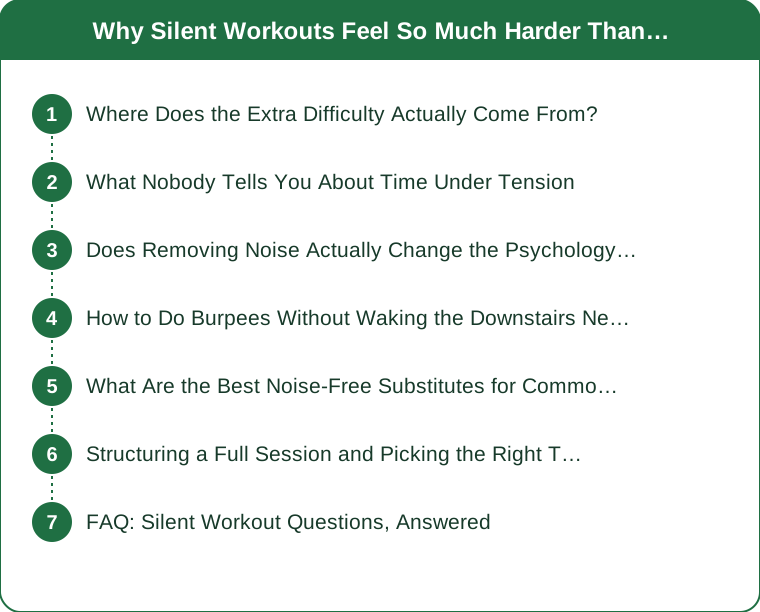
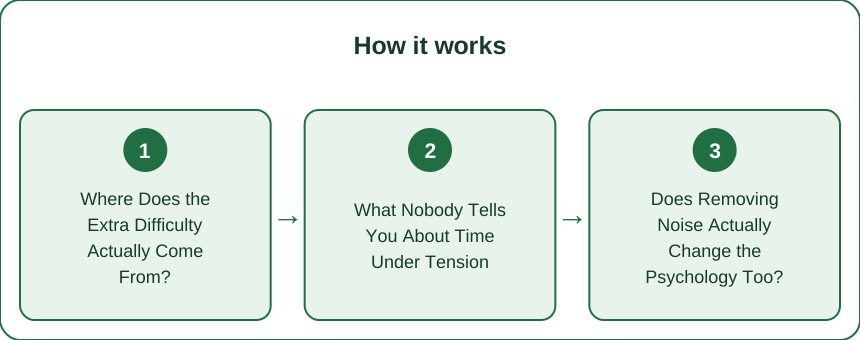
Where Does the Extra Difficulty Actually Come From?
Jumping movements use the stretch-shortening cycle — your muscles and tendons store and release elastic energy on landing, which reduces the pure muscular work needed for the next rep. Take away the jump (swap a jump squat for a slow squat, for instance) and every rep has to be powered entirely by muscle contraction, with none of that free elastic assist. That’s a real, measurable increase in muscular demand, not just a feeling.
What Nobody Tells You About Time Under Tension
Quiet workouts almost always default to slower tempo movements, because slow is quiet and fast tends to create noise and impact. Slower tempo means more time under tension per rep, which is one of the more fatiguing training variables — a 4-second squat descent burns differently than a 1-second one, even at the same rep count. This is why a 20-minute silent routine can leave you shakier than a 20-minute jump-heavy one.
Does Removing Noise Actually Change the Psychology Too?
Yes — loud workouts (thumping music, audible breath, impact sounds) provide external feedback that you’re working hard, which paradoxically can make hard efforts feel more bearable because your brain gets confirmation it’s ‘supposed to’ feel this way. In silence, there’s no auditory cue reinforcing effort, so the same physical exertion can register as more mentally taxing because it feels unvalidated.

How to Do Burpees Without Waking the Downstairs Neighbor
Replace the jump-back and jump-in with a step-back plank walkout and step the feet back in one at a time instead of jumping. Skip the final jump and instead do a controlled stand with a calf raise at the top. It’s quieter, and — per the elastic-energy point above — noticeably harder on your legs, so don’t be surprised if you need fewer reps for the same effort.
What Are the Best Noise-Free Substitutes for Common Loud Moves?
Jump squats → tempo squats (3 sec down, 1 sec pause, controlled up). Jumping jacks → standing mountain climbers or step-touches. Box jumps → step-ups with a pause at the top. High-impact HIIT intervals → isometric holds (wall sits, plank variations) at matched work/rest ratios. Each swap keeps the muscle group and intensity in a similar range while removing the floor impact.
Structuring a Full Session and Picking the Right Time
How Should You Structure a Full Quiet Session?
Because slow-tempo, no-jump work is more taxing per rep, drop your total rep count by roughly 20-30% compared to your usual loud routine, and add 10-15 seconds of extra rest between sets. A good quiet full-body structure: 5 exercises, 40 seconds work / 20 seconds rest, 3 rounds — squats, push-ups, reverse lunges, plank shoulder taps, and glute bridges, none of which require any equipment or produce meaningful floor noise.
What Time of Day Works Best for Apartment Workouts?
If noise is a concern for neighbors, late morning through early evening (roughly 10am-8pm) is generally the safest window in most buildings — early morning and late night are when impact and voice carry loudest through shared walls and floors, even at low volumes.
FAQ: Silent Workout Questions, Answered
Will a no-jump workout still improve my cardio fitness?
Yes — slow-tempo strength circuits with short rest periods still elevate heart rate significantly; you’re trading impact-based cardio for tension-based cardio, not losing the cardio benefit entirely.
Do I need any equipment for a fully silent workout?
No — bodyweight tempo work covers a full session; a yoga mat helps cushion sound further if you’re on a hard floor.
Why do my muscles feel more sore after quiet workouts than loud ones?
The increased time under tension from slower, non-explosive movement typically produces more delayed-onset muscle soreness than fast, momentum-assisted reps at the same rep count.
TL;DR:
- Removing jumps removes free elastic energy, so muscles do more raw work
- Slower, quieter tempo means more time under tension — a real fatigue driver
- Silence removes the auditory feedback that normally validates hard effort
- Swap jumps for tempo and step-based variations, same muscles, less noise
- Reduce total reps ~20-30% and add rest since each rep costs more
The extra difficulty is real, not just perception — you’re training with fewer physical shortcuts available.
Keep Reading
This article is for general informational and styling purposes only. Fit, sizing, and product availability may vary.